



Hiring someone in another country does not have to mean opening a local entity first. An Employer of Record, or EOR, lets a company legally employ workers in countries where it does not have its own legal entity. The EOR becomes the worker’s legal employer for payroll, tax, benefits, contracts, and local employment compliance, while the client company continues to manage the employee’s day-to-day work.
For companies expanding internationally, this can remove one of the biggest barriers to hiring: the need to understand and set up employment infrastructure country by country before making a hire.
What Is an Employer of Record?
An Employer of Record is a third-party organization that legally employs workers on behalf of another company.
In an EOR arrangement, the EOR appears as the legal employer on the employee’s local employment agreement and is responsible for many of the obligations that come with employing someone in that country. Those obligations can include payroll, tax withholding, statutory benefits, social contributions, employment documentation, required registrations, and local labour-law compliance. According to recent research, 87% of companies planning expansion say that meeting local tax and employment regulations will be their hardest task in 2026.
The client company, meanwhile, remains responsible for the employee’s actual work. It decides what the employee does, who they report to, what goals they are working toward, how their performance is managed, and how they fit into the broader team.
A simple way to think about it is this:
- The EOR manages the employment relationship on paper and in payroll.
- The client company manages the employee’s work.
- The employee works as part of the client company’s team while being legally employed by the EOR.
This structure makes it possible to hire employees in countries where your company does not have a local subsidiary or other employing entity.
For example, imagine a Canadian software company finds the right product designer in Germany. The company wants to hire the person as an employee, but it does not have a German legal entity. Instead of incorporating a German company, registering for payroll, opening local accounts, arranging benefits, and learning German employment requirements from scratch, it can use an EOR with the infrastructure to employ that person locally.
The employee would still work with the Canadian company’s team and managers. The EOR would handle the German employment agreement, payroll, required contributions, statutory benefits, and other local employment obligations.
That is the core value of the EOR model: it separates the need to hire from the need to establish a legal entity.
How Does an EOR Work?
The exact process varies by provider and country, but most EOR arrangements follow a similar structure.
First, the client company identifies the employee it wants to hire and chooses the country where the worker will be employed. The EOR then confirms whether the role can legally be employed through its local infrastructure and gathers the information required to prepare the employment arrangement.
Next, the EOR prepares a locally compliant employment agreement. This agreement is signed between the employee and the EOR because the EOR is the legal employer. The commercial relationship between the client company and the EOR is governed by a separate service agreement.
Once the employee is onboarded, the EOR registers the worker where required, sets up payroll and benefits, manages statutory deductions, and pays the employee according to local payroll rules. The client company funds the employment costs and the EOR’s service fee.
The client company continues to direct the employee’s daily work. The employee can usually use the client company’s email, systems, processes, internal tools, job title, and reporting structure just like any other member of the team.
If the employee later leaves the company, the EOR manages the legal employment steps required in that country, while working with the client company on timing, documentation, final pay, notice, severance, accrued leave, or other obligations that may apply.
What Does an EOR Cover?
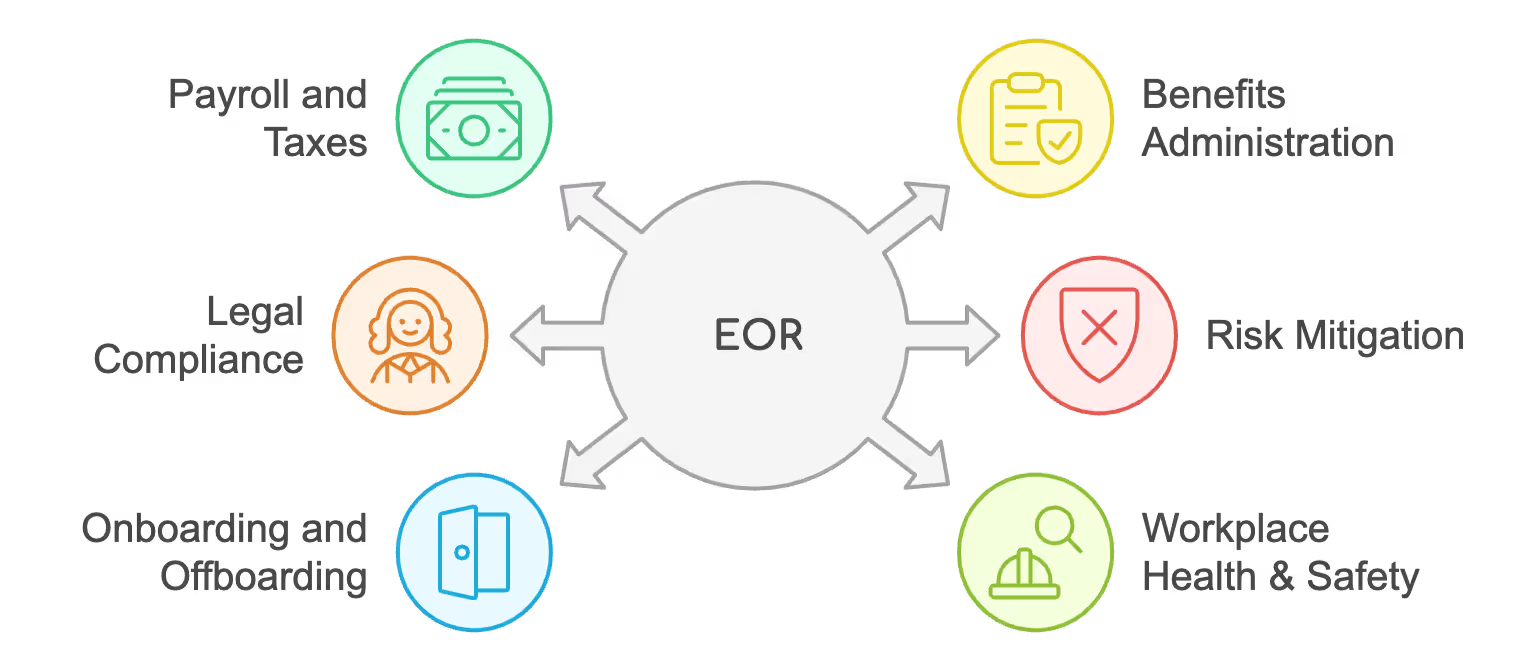
An EOR provides the local employment infrastructure required to legally employ someone in a country where the client does not have its own employing entity. The exact scope varies by provider and jurisdiction, but most EOR services cover the following areas.
Employment contracts
The EOR prepares a locally compliant employment agreement covering compensation, title, working arrangement, benefits, leave, notice, probation, and other required terms.
This matters because employment contracts are not interchangeable across countries. Some jurisdictions require local-language agreements or specific clauses, while rules around probation, working hours, termination, intellectual property, and notice can vary significantly.
Payroll
The EOR runs payroll in accordance with local rules. This typically includes calculating gross-to-net pay, applying statutory deductions, withholding taxes, calculating employer contributions, producing payslips, and paying the employee in the appropriate currency. For example, an EOR hiring in Canada would handle Canada Pension Plan contributions and provincial tax variations, while an EOR hiring in the United States would manage Social Security and Medicare withholdings.
Payroll requirements can also include country-specific rules for bonuses, overtime, expenses, 13th-month pay, social contributions, and reporting. For country-specific information, see our Country Guides.
Taxes and statutory contributions
The EOR handles employment-related tax withholding and required employer contributions.
For example, an EOR employing someone in Canada may account for federal and provincial income tax deductions, Canada Pension Plan or Quebec Pension Plan contributions, and Employment Insurance. In the United States, requirements may include federal payroll taxes, Social Security, Medicare, unemployment taxes, and state-level obligations.
Benefits administration
EORs typically administer required benefits and can often support supplementary benefits chosen by the client.
Depending on the country, this may include healthcare, pension contributions, paid leave, parental leave, meal allowances, transportation benefits, or private insurance. A good provider should explain what is legally required and what is commonly expected in the local market.
Employee registrations
Many countries require employees to be registered with tax authorities, social security systems, pension programs, insurance schemes, or other government bodies. The EOR handles those registrations as the legal employer and maintains the relevant employment records.
Work authorization and immigration support
Some EORs can support work permits, visa sponsorship, or immigration coordination. Availability varies by country and provider.
Using an EOR does not automatically give someone the right to work in a country. The employee still needs valid work authorization, and some visa categories or roles may not be compatible with an EOR structure.
Leave administration
The EOR helps apply local rules for vacation, sick leave, parental leave, public holidays, and other protected absences. This is particularly useful for companies with global teams because leave entitlements can differ dramatically between countries.
Compliance support
The EOR helps the employment arrangement follow local rules around contracts, minimum standards, statutory leave, working time, benefits, payroll, and termination.
That does not remove every legal responsibility from the client. The client still needs to manage areas such as workplace conduct, performance, discrimination, harassment, data handling, intellectual property practices, and the way the employee is actually supervised.
Onboarding and offboarding
During onboarding, the EOR generally collects employee information, prepares the employment agreement, completes required registrations, and sets up payroll and benefits. The client company handles role-specific onboarding, equipment, systems access, team introductions, and goals.
When employment ends, the EOR supports the local legal process, which may include notice, final payroll, accrued leave, severance, required documentation, and government filings. Because termination rules vary widely, companies should involve the EOR before communicating a termination decision.
Workplace policies and health and safety
Depending on the country, the EOR may also support required employment policies, health and safety obligations, remote-work requirements, and related documentation. For remote workers, local rules may cover home-office arrangements, expense reimbursement, equipment, or safety assessments.
What Does an EOR Not Cover?
An EOR handles the legal and administrative side of employment, but it does not run the employee’s job for you.
The client company remains responsible for areas such as:
- Day-to-day management
- Role responsibilities
- Work assignments
- Team structure
- Performance expectations
- Promotions and career development
- Internal culture
- Business strategy
- Product or service decisions
- Most operational supervision
The EOR may advise on how certain management decisions interact with local employment law, particularly around performance management or termination, but it does not replace the employee’s actual manager.
This distinction is important. An EOR is employment infrastructure, not an outsourced management team.
When Should You Use an EOR?
An EOR is most useful when your company needs to employ someone in a country where you do not have the infrastructure to do so directly.
1. You want to hire in a new country without opening an entity
This is the most common use case. If you find the right candidate in another country but do not have an entity there, an EOR can provide the local employment structure needed to hire them as an employee.
This is especially useful when the hire is driven by talent rather than a broader market-entry plan. There may be no reason to open an entire subsidiary for one engineer, salesperson, designer, finance leader, or specialist.
2. You want to test a market first
Opening a foreign entity can require incorporation, tax registration, accounting, payroll setup, banking, ongoing filings, and local professional support.
If you are still validating demand in a new market, an EOR lets you hire locally without making that full commitment. If the market grows, you can later establish an entity and transition employees to direct employment.
3. You need to hire quickly
Entity setup can take weeks or months. An EOR can shorten the path to employment because the local infrastructure already exists.
The exact start date still depends on the country, employee documentation, work authorization, background checks, payroll cutoffs, and the employee’s own notice period.
4. You want to hire talent wherever it is located
An EOR can expand your recruiting pool beyond countries where you already have entities. That can be useful for specialized technical skills, regional sales expertise, language requirements, customer support, finance, operations, and other hard-to-fill roles.
5. You only need a small team in a country
For one or a few employees, the cost and effort of maintaining a local entity may outweigh the benefit. An EOR lets you access employment infrastructure as a service instead.
As headcount grows, the economics may shift and direct employment through your own entity may become more attractive.
6. You need a bridge during a transition
An EOR can sometimes support employees during an acquisition, restructuring, entity closure, or period while a new local entity is being established.
7. An existing employee wants to relocate
If an employee moves permanently to a country where you do not have an entity, simply continuing the existing arrangement can create payroll, tax, immigration, social security, and employment-law issues.
An EOR may provide a compliant way to retain the employee in the new location, depending on the role, work authorization, local rules, and tax considerations.
8. You are concerned about contractor misclassification
Hiring someone as a contractor does not make them one under local law. If the relationship functions like employment, the company may face back taxes, contributions, penalties, or benefits claims.
Where the role is genuinely an employment relationship, an EOR can provide a more appropriate structure.
Advantages of Using an EOR
EORs can solve a number of practical problems for companies building international teams.
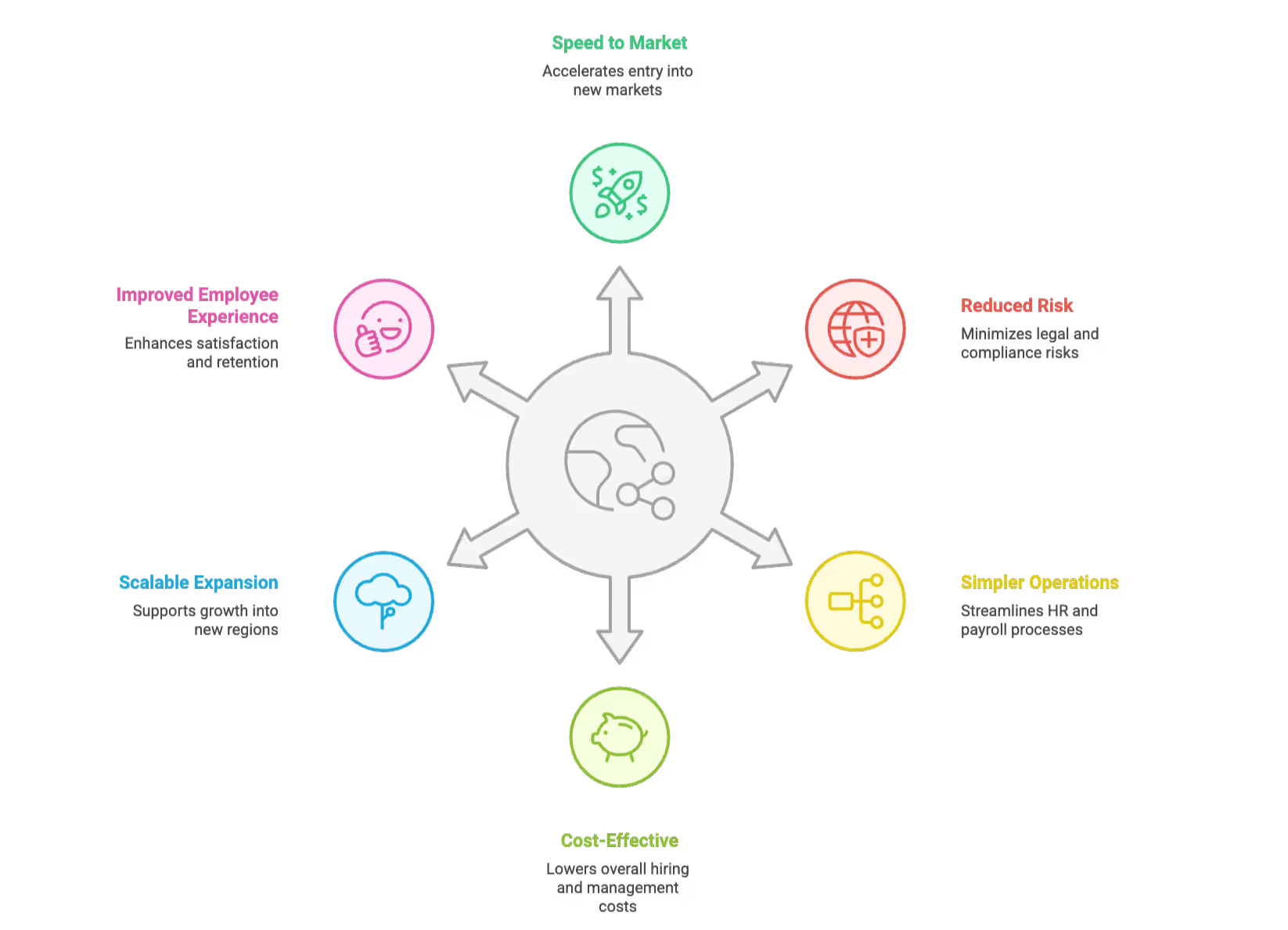
Faster international hiring
The biggest advantage is speed. Because the EOR already has employment infrastructure in the country, the client company does not need to complete incorporation and payroll setup before making the hire.
That can shorten the distance between finding the right candidate and legally employing them.
No local entity required
An EOR lets a company employ workers in a country without opening and maintaining its own legal entity there.
This can reduce the administrative overhead associated with incorporation, local accounting, recurring corporate filings, payroll registrations, banking, directors, tax compliance, and entity maintenance.
Access to global talent
Without an EOR, companies may limit recruiting to countries where they already have entities. EOR infrastructure makes it easier to hire based on skill, experience, language, or market knowledge rather than only geography.
Local employment expertise
Employment rules differ widely by jurisdiction. An EOR can provide local guidance on contracts, statutory benefits, leave, payroll, notice periods, severance, working-time rules, and other employment requirements.
This is particularly valuable for companies making their first hire in a market.
More consistent global operations
A multi-country EOR platform can centralize employment information across several markets. Instead of managing different payroll vendors, lawyers, benefit brokers, and local providers in each country, the company can use one system and one commercial relationship for multiple hires.
Lower operational burden for small teams
For a small number of employees, building local HR and payroll operations may be disproportionate to the size of the team. An EOR gives the company access to infrastructure it would otherwise have to build itself.
Flexibility
An EOR can support a company while it determines whether a market is temporary, experimental, or strategic.
That flexibility is useful for startups, distributed companies, project-based hiring, acquisitions, and organizations entering several countries at once.
Disadvantages of Using an EOR
An EOR can simplify international hiring, but there are trade-offs. Companies should understand them before deciding whether the model is right for a particular market.
Higher per-employee service cost
An EOR adds a service fee on top of salary, employer taxes, statutory contributions, and benefits.
For one or a few employees, that fee can be far cheaper than opening and running an entity. But as headcount increases, the cumulative monthly EOR fees may eventually exceed the cost of operating a local entity.
This is why companies should compare the total cost of both models rather than looking only at the EOR fee.
Less direct control over the legal employment relationship
The employee works for the client company operationally, but the EOR is the legal employer.
That means some employment changes need to be processed through the EOR. Contract amendments, salary changes, benefits updates, leaves, and terminations may require coordination rather than being handled entirely in-house.
Employee experience depends partly on the EOR
Payroll accuracy, benefits support, response times, onboarding, and HR administration all affect the employee’s experience.
If the EOR’s support is slow or its payroll process is unreliable, the employee may associate those problems with the client company even though a third party is administering the employment.
Country and role restrictions can apply
EOR arrangements are not identical everywhere. Some countries impose licensing rules, time limits, sector restrictions, headcount restrictions, or limitations on which roles can be employed through an EOR-type structure.
Certain regulated professions, immigration situations, executive roles, or business activities may require a different setup.
It may not solve corporate tax or permanent-establishment risk
An EOR solves employment infrastructure. It does not automatically eliminate every tax issue created by operating in another country.
Depending on what the employee does, especially if they negotiate contracts, generate revenue, act with authority on behalf of the company, or perform core business functions, the company may still need advice on permanent-establishment or corporate tax exposure.
Not always the best long-term structure
If a company plans to build a substantial team, open an office, sign local contracts, establish a local brand presence, or generate significant revenue in the country, setting up an entity may eventually make more sense.
An EOR is often best viewed as one option in a broader international expansion strategy, not a universal replacement for foreign entities.
EOR vs Staffing Agency vs PEO
EORs are often confused with staffing agencies and Professional Employer Organizations, or PEOs. The models overlap in some areas, but they solve different problems.
EOR vs staffing agency
A staffing agency primarily helps companies find workers. Many focus on temporary, contingent, or contract placements, although business models vary.
An EOR is usually used after the company has identified the worker it wants to hire. Its primary role is to provide the legal employment infrastructure for that worker.
The simplest distinction is:
- Staffing agency: helps source or place talent.
- EOR: helps legally employ talent in a country where the client may not have an entity.
Some staffing firms also act as the legal employer, so companies should look at the actual contract structure rather than relying only on the provider’s label.
EOR vs PEO
The difference between an EOR and PEO is that a PEO typically works through a co-employment model. The client company already has a local employing entity, while the PEO takes on selected HR, payroll, benefits, or administrative responsibilities.
An EOR becomes the legal employer and can therefore support hiring where the client does not have a local entity.
In practical terms:
How Much Does an EOR Cost?
EOR pricing varies by provider, country, employee profile, and service scope.
The two most common pricing models are a flat monthly fee per employee and a percentage of payroll.
Flat monthly fee
Many global EOR providers charge a fixed monthly fee for each employee. The fee may vary by country or be standardized across markets.
This model can make budgeting easier because the service cost is predictable even when employee salaries differ.
Percentage of payroll
Some providers charge a percentage of the employee’s salary or total payroll cost.
This means the EOR fee rises as compensation increases. Percentage-based models can be simple, but they may become expensive for senior or highly paid employees.
Costs beyond the EOR fee
The service fee is only one part of the total cost of employment.
When considering the total cost of an EOR, companies should also budget for:
- Gross salary
- Employer payroll taxes
- Social security contributions
- Pension contributions
- Mandatory benefits
- Supplementary benefits
- Insurance
- Statutory bonuses or allowances
- Paid leave obligations
- Payroll-related charges
- Currency conversion or payment fees where applicable
There may also be extra charges for services such as:
- Visa or immigration support
- Custom benefits
- Equity administration
- Background checks
- Equipment or device management
- Off-cycle payroll
- Complex expense processing
- Termination support
- Legal review
- Country-specific registrations
The best way to compare providers is to request the total monthly employer cost for a real hiring scenario rather than comparing only advertised platform fees.
EOR vs Setting Up a Local Entity
Choosing between an EOR and a local entity depends on the size, permanence, and strategic importance of your operation in a country.
An EOR tends to be a strong option when:
- You are making your first few hires
- You need to move quickly
- You are testing a new market
- You do not need a local operating company
- You want to reduce entity maintenance
- Your headcount is still small
A local entity may make more sense when:
- You expect to build a large team
- You need local contracts with customers or suppliers
- You require licenses that must sit with your own entity
- You are opening an office or physical operation
- You want more direct control over employment and benefits
- The economics of ongoing EOR fees no longer make sense
- Tax, regulatory, or permanent-establishment considerations require a direct local structure
For many companies, the answer changes over time. An EOR can support the first stage of expansion, and a local entity can become the better fit once the market reaches sufficient scale.
How to Choose an Employer of Record
Not all EOR providers offer the same level of local control, payroll reliability, service, or technology. Focus on how the provider actually operates in the countries where you plan to hire.
1. Country coverage and entity model
Confirm that the provider can legally employ workers in your priority markets. Then ask how it delivers the service: through its own local entities, third-party partners, or a mix of both.
The operating model can affect support, payroll timelines, pricing, visibility, and how many parties are involved when something goes wrong.
2. Local expertise
Ask how the provider handles country-specific contracts, statutory benefits, leave, payroll changes, working-time rules, collective agreements, and terminations.
A strong EOR should be able to explain both what is legally required and what is customary in the local market.
3. Payroll reliability
Understand payroll cutoffs, funding timelines, bonus processing, expenses, off-cycle payroll, payment methods, currency handling, corrections, and escalation procedures.
Payroll is one of the most visible parts of the employee experience, so reliability matters as much as onboarding speed.
4. Pricing transparency
Request a full cost breakdown, including the monthly EOR fee, setup charges, funding requirements, FX charges, benefit costs, immigration fees, off-cycle payroll fees, and termination support.
Compare total cost, not just the advertised platform price.
5. Employee support
Find out who employees contact about payslips, benefits, taxes, leave, or employment documents and whether support is available in relevant time zones.
6. Technology and integrations
The platform should make it easy to view employee records, contracts, payroll, invoices, benefits, expenses, and employment status. If you use an HRIS, payroll system, finance platform, or identity tools, check how data moves between systems.
7. Security and data handling
EORs process sensitive information such as bank details, tax records, compensation, identity documents, and contracts. Review the provider’s security controls, privacy practices, access management, and data-processing terms.
8. Complex employment support
Ask how the provider handles underperformance, redundancies, protected leave, employee disputes, terminations, and immigration. These situations often reveal more about an EOR’s quality than a standard onboarding process.
Modern EOR platforms also increasingly use automation for contract generation, compliance workflows, document management, payroll preparation, and employee support. For example, Borderless AI combines EOR infrastructure with AI-powered tools designed to help companies manage global hiring, payroll, and compliance through one platform.
In Which Countries Are EOR Services Available?
EOR services are available in many major hiring markets around the world, including:
- United States
- Canada
- United Kingdom
- Germany
- Australia
- France
- Netherlands
- Japan
- Singapore
- Brazil
- Mexico
- South Africa
- United Arab Emirates
However, EOR availability is not identical in every market. Local rules may affect which industries, roles, employment durations, or worker types can be supported.
Before making an offer, companies should confirm that their provider can legally employ the specific worker in the specific country and role.
If you are comparing countries, a country explorer can also help you review local employment costs, payroll rules, benefits, leave requirements, and hiring considerations before deciding where to build your team.
Is an EOR Right for Your Company?
An EOR is a strong option when you want to hire internationally without first building local corporate infrastructure.
It is particularly useful for first hires in a country, distributed teams, market testing, employee relocations, small international teams, and situations where speed matters.
But it is not automatically the right structure forever. As headcount grows, revenue increases, or the company develops a deeper operating presence in a market, a local entity may offer better economics or more control.
The best approach is to treat the EOR as part of a broader global hiring strategy. For each country, compare the cost, speed, compliance burden, headcount plans, tax implications, and level of local presence you expect to need.
Scaling Across Borders With Confidence
Hiring internationally no longer has to begin with a foreign incorporation project.
An Employer of Record can give companies a practical way to employ people in new countries while outsourcing much of the payroll, tax, benefits, contract, and local employment administration that would otherwise require local infrastructure.
That makes the model especially useful for companies that want to move quickly, hire specialized talent, test new markets, or build distributed teams without creating an entity in every country.
Borderless AI provides Employer of Record services around the world, combining global employment infrastructure with AI-powered tools for hiring, payroll, and compliance. Companies can use the platform to onboard and manage international employees while keeping employment information, documents, payroll, and compliance workflows in one place.
The goal is not simply to make international hiring possible. It is to make the employment experience manageable for the company and the employee as the team grows across borders.
FAQs About Employer of Record Services
What is the difference between an EOR and a global PEO?
An EOR is the legal employer and can usually support hiring where the client does not have a local entity. A PEO generally uses a co-employment structure in which the client already has a local entity and outsources selected HR, payroll, or benefits functions.
How quickly can an EOR help a company hire internationally?
It depends on the country and provider. In straightforward cases, an EOR can usually onboard an employee much faster than a company could establish a new entity. Start dates can still depend on payroll cutoffs, registrations, work authorization, background checks, documentation, and the employee’s notice period.
Can an EOR hire contractors as well as employees?
An EOR is designed for employees. Many EOR providers also offer contractor-management services, but the legal relationship is different. If someone functions like an employee under local law, classifying them as a contractor can create misclassification risk.
What happens if I want to convert an EOR employee to direct employment?
Once your local entity is ready, the employee can usually transition to direct employment. The process may involve ending the EOR agreement, issuing a new contract, coordinating payroll, transferring benefits where possible, and dealing with accrued leave or tenure according to local law.
What is an example of an EOR?
Suppose a U.S. software company wants to hire a developer in Japan but does not have a Japanese entity. An EOR can employ the developer locally, issue the employment agreement, run payroll, administer required benefits, and manage local employment obligations. The U.S. company still manages the developer’s work and performance.
How do EORs handle terminations?
The EOR works with the client to follow local rules, which may include notice, severance, documented grounds, consultation, final payroll, unused leave payout, or required filings. Because termination law varies significantly, companies should involve the EOR before communicating a decision.
Are there limitations to what an EOR can do?
Yes. An EOR does not manage the employee’s daily work and may not be suitable for every role, industry, immigration situation, or jurisdiction. It also does not automatically eliminate corporate tax, permanent-establishment, licensing, data-protection, or other regulatory issues created by the company’s activities in the country.
How do AI-powered EORs differ from traditional EOR services?
AI-powered EOR platforms use automation to reduce manual work in areas such as contract generation, compliance workflows, payroll preparation, document management, and employee support. The underlying employment obligations are still governed by local law, so technology works best when paired with strong local expertise.
Is it easier to open an entity in another country or use an EOR?
For a small number of hires, an EOR is usually faster and simpler because the employment infrastructure already exists. Opening an entity can require incorporation, tax registration, banking, payroll setup, accounting, recurring filings, and corporate governance.
Is an EOR the legal employer?
Yes. In a standard EOR arrangement, the EOR is the legal employer. The client company directs the employee’s day-to-day work, while the EOR manages the formal employment relationship and related administration.
Can EOR employees still feel like part of our company?
Yes. They can use the client company’s email, tools, job titles, reporting lines, meetings, and internal processes. The employee experience depends heavily on how the client includes them in communication, career development, management, and culture.
When should we move from an EOR to our own entity?
There is no universal headcount threshold. The answer depends on cost, strategic importance, tax exposure, local revenue, hiring plans, regulatory needs, and how much control the company wants over employment and benefits.
A common approach is to use an EOR for early hires, monitor how the market develops, and compare the total cost of the EOR model against the cost of establishing and maintaining an entity as the team grows.