


Why teams look for a RemoFirst alternative
RemoFirst deserves credit where it's due. Starting at approximately $199 per employee per month with coverage in 185+ countries, it's one of the most budget-friendly EOR platforms on the market. For early-stage teams making their first international hire, that's genuinely appealing.
So why do over 20% of global-HR teams eventually start shopping around?
It rarely happens overnight. A company signs with RemoFirst, hires a few people in Portugal and the Philippines, and things work fine. Then a compliance question surfaces and the support response takes three days. Or payroll runs late in one country because the local partner missed a deadline. Or the finance team calculates the real monthly cost — after deposits, FX markups, and pre-funding — and realizes the "$199/month" math doesn't add up.
The pattern is consistent. RemoFirst relies heavily on third-party partner entities rather than owned legal infrastructure in many countries. That's not inherently wrong — it's how they keep costs low — but it introduces variability. Support quality depends on the local partner. Compliance posture depends on the local partner. Payroll timing depends on the local partner.
The other recurring themes: slower-than-expected support response, limited platform automation compared to newer entrants, and total costs that creep higher once you factor in salary deposits, FX markups, and pre-funding requirements buried in the fine print.
None of this makes RemoFirst a bad choice. It makes it a trade-off. The question is whether that trade-off fits your team's risk tolerance and operational needs.
How to evaluate a RemoFirst alternative (the axes that actually matter)
Before you compare logos and pricing tiers, define the criteria that actually move the needle for your team. Here's a rubric worth stealing.
Entity ownership
Does the provider own its legal entities in each country, or does it route employment through local partners? Owned entities typically mean more consistent compliance, faster issue resolution, and direct accountability. Partner networks can work fine, but they introduce a layer of variability and handoff risk.
Total cost of ownership
The sticker price rarely tells the whole story. Ask about salary deposits (some providers require 1–2 months upfront per employee), pre-funding requirements, FX markups on currency conversion, and per-transaction fees. A "$199/month" plan can quietly become $400+ when the fine print kicks in.
Payroll and onboarding speed
How long does onboarding actually take — not the marketing claim, but the calendar-days reality? And once employees are active, how fast does payroll process? The industry norm hovers around 20–30 days. Faster providers (3–5 days) exist, and the difference matters for both cash-flow management and employee trust.
Support model
Is support in-house or outsourced? Where is the team located, and what are the response SLAs? A lot of EOR frustration traces back to ticket queues, time-zone mismatches, and having to explain your issue three times to three different people. 24/7 in-house support isn't a luxury — it's often the difference between a minor hiccup and a payroll fire drill.
Platform and automation
"AI-powered" is a marketing checkbox for some providers — a search bar with a rebrand. For others, it's genuine workflow automation: contract generation, compliance alerts, payroll processing, and HR support built into the product. The difference shows up in your team's day-to-day workload. Does the platform generate compliant contracts in minutes, or does your HR lead spend hours on manual document prep? Does the system flag labor-law changes proactively, or does your legal team find out the hard way? Ask for a demo and click around before you commit.
At-a-glance comparison: RemoFirst alternatives
Here's a side-by-side snapshot. Pricing and coverage figures are approximate and subject to change — always confirm directly with each provider.
The 7 best RemoFirst alternatives in 2026
Borderless AI: Fastest Payroll, Easiest to Use and Best for Avoiding Upfront Deposits
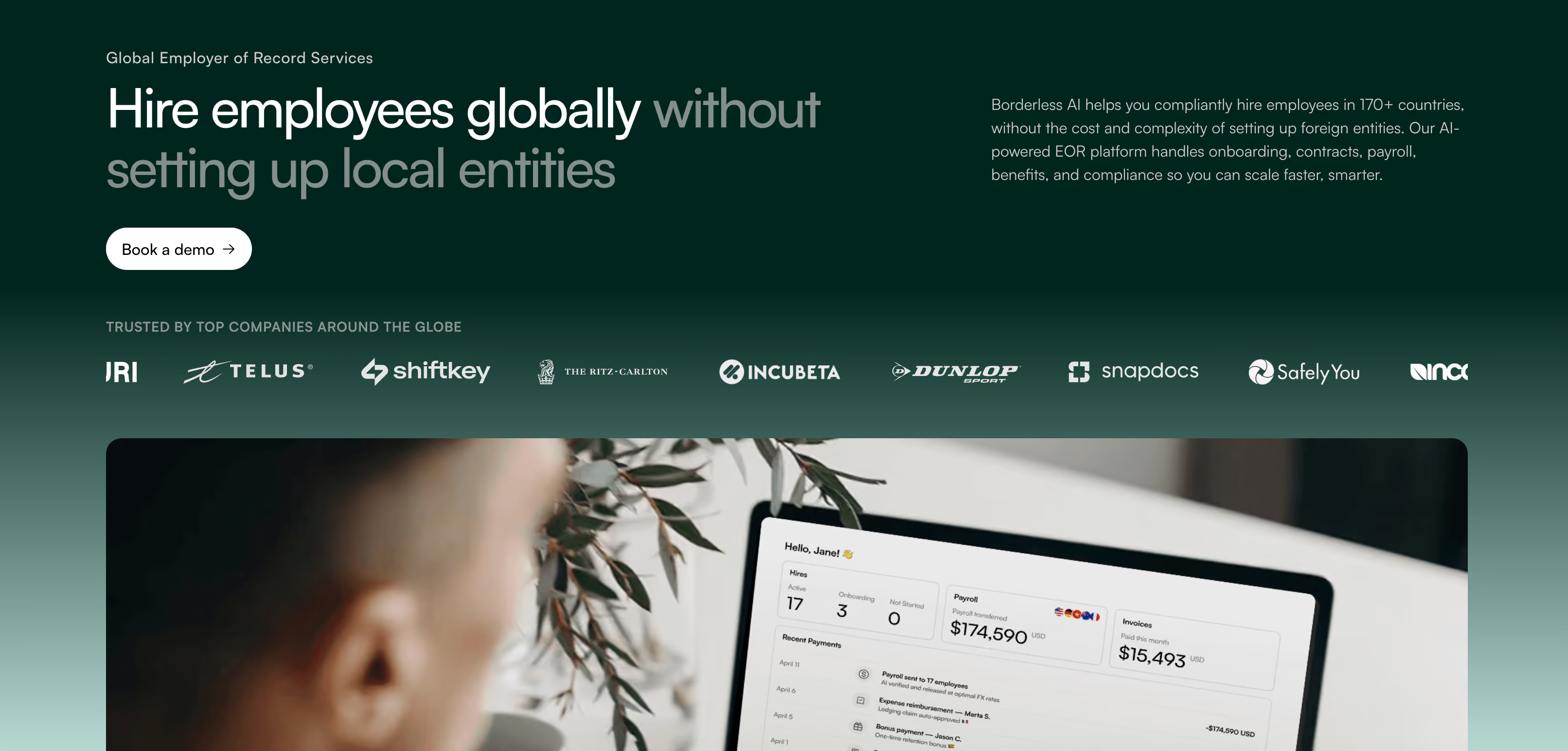
Borderless AI is built for teams who want the simplicity RemoFirst promises without the partner-network trade-offs.
The platform covers 170+ countries through 100% owned legal entities — no third-party handoffs. Payroll runs in 3–5 days versus the industry's 20–30 day norm, and there are zero salary deposits or pre-funding requirements. That's a real cash-flow difference if you're hiring at any scale.
What actually sets it apart: AI is built into the core product, not bolted on as a search bar. HRGPT handles HR questions in real time. The Contract Generator produces compliant local contracts in minutes. Compliance alerts stay ahead of changing labor laws. The platform integrates natively with Workday and ADP Workforce Now for teams already embedded in those systems.
Support is 24/7, in-house, and North American-based — real humans who know payroll and compliance, not a ticket queue. G2 users rate it 4.9 out of 5, which tracks with the consistent support experience.
Watch-outs: Borderless AI is a newer entrant than decade-old players like Deel or Remote. If your procurement team prioritizes tenure over capability, that matters. It's also not the cheapest option — it's built for teams who value speed, automation, and owned-entity compliance over the absolute lowest sticker price.
Deel: Widest all-in-one ecosystem
Deel has become the Swiss Army knife of global workforce platforms. EOR, contractor payments, global payroll, HRIS, immigration, equipment — it's all there, often under one roof.
Coverage spans 150+ countries, and the breadth of features means you can probably consolidate tools. For teams that want one vendor for everything, that's a real simplification. Deel's market presence is hard to ignore; they've raised significant capital, acquired multiple companies, and built name recognition that makes procurement conversations easier at some organizations.
Watch-outs: Breadth has a cost. Deel sits at the premium end of the pricing spectrum (starting around $599/employee/month), and the sales motion tends toward upsells. Not all entities are owned — some countries route through partners, so confirm the entity model for your specific markets. And the sheer size of the platform can mean slower support response and less personalized service than smaller, focused providers. Some users report that post-sale account management feels transactional.
Remote: best for owned-entity compliance depth
Remote's positioning is compliance-first. The company invests heavily in owned legal entities and local HR expertise, particularly in Europe, the UK, and major markets. If your legal or finance team loses sleep over employment risk, Remote speaks their language.
Benefits administration is strong, and the platform is well-regarded for handling complex situations (equity, benefits, local labor nuances) thoughtfully.
Watch-outs: Coverage is narrower than the marketing suggests. Remote owns entities in 85+ countries but offers coverage in more via partners — check whether your target countries are owned or networked. Pricing starts around $599/employee/month, so it's not the budget tier. The platform is less automation-forward than newer entrants.
Multiplier: cheapest price
Multiplier is the closest RemoFirst positioning in this list: competitive pricing (starting around $400/employee/month), a clean modern interface, and coverage in 150+ countries. For teams prioritizing cost efficiency without sacrificing UX, it's a reasonable middle ground.
The onboarding flow is straightforward, and the platform handles the basics well. The dashboard is intuitive, the mobile experience is solid, and the overall product polish is ahead of some legacy players. If your HR team cares about day-to-day usability, that matters.
Watch-outs: Entity ownership is mixed — some countries are owned, others use partners, so do your due diligence on your specific markets. Check the fine print on deposits and pre-funding requirements; they vary by country. Support quality has been uneven in user reviews, particularly outside North American hours.
Oyster
Oyster built its brand around remote-first culture and benefits that actually work across borders. If your team is fully distributed and you want a provider that "gets" async work, Oyster aligns culturally. Benefits tooling is a standout — health insurance, wellness stipends, and equity administration are woven into the platform. Coverage spans 180+ countries, though the entity mix (owned vs partner) varies.
Watch-outs: Pricing starts at the higher end (around $599/employee/month). The platform is better suited for teams that prioritize culture and benefits over pure speed or automation. Entity ownership is mixed, so check your specific markets.
Papaya Global: best for enterprises
Papaya Global is engineered for scale. If you're a mid-market or enterprise company with hundreds or thousands of employees across dozens of countries, and payroll consolidation is the priority, Papaya's infrastructure handles volume.
The payments backbone is robust, compliance tooling is deep, and the platform can ingest complex payroll data from multiple sources.
Watch-outs: Enterprise infrastructure comes with enterprise pricing (starting around $650/employee/month) and enterprise complexity. Smaller teams often find the platform overkill for their needs. Implementation can be heavier-lift than lightweight alternatives. Entity model is mixed.
If Papaya is on your shortlist too, our Papaya Global alternatives guide breaks down where it leads and who beats it on price and speed.
Native Teams: best for contractor-heavy small teams
Native Teams sits at the budget end of the spectrum (starting around $99/employee/month) with a focus on contractor and freelancer payments. For small teams that work primarily with contractors and occasionally need EOR for a single employee, it's a cost-effective option.
The platform is straightforward and handles basic use cases without fuss. The contractor payment flows are simple, and the pricing model is transparent enough for small teams to forecast costs accurately.
Watch-outs: Coverage is narrower (85+ countries), entity ownership is partner-based, and enterprise-grade depth is limited. If you're scaling beyond a handful of hires or need robust compliance tooling, you'll likely outgrow it. The platform lacks the automation and AI capabilities of more modern entrants.
How to switch from RemoFirst without disrupting payroll
Switching EOR providers sounds painful but it doesn't have to be. Just be mindful about the handoff process.
1. Discovery and audit
Map your current employees, contracts, entities, and notice periods in RemoFirst. Identify any country-specific termination rules or benefits portability constraints. This is your migration checklist.
2. Plan for overlap
Run parallel for at least one payroll cycle. Your new provider onboards employees while RemoFirst still processes the current month's pay. Check RemoFirst's offboarding terms, most EORs require 30 days' notice.
3. Contract and entity transfer
Your new EOR generates fresh compliant contracts. Employees formally resign from the RemoFirst entity and onboard to the new entity (usually same-day effective dates). Benefits continuity matters, confirm health insurance and other coverage transfers without gaps.
4. First payroll cycle
Validate employee data, bank details, FX rates, and pay dates before cutover. Run a test cycle if your provider supports it. Communicate proactively with employees, nobody likes payroll surprises.
AI-native platforms like Borderless AI typically complete onboarding in 24 to 48 hours, and in-house support teams can troubleshoot issues in real time. That compresses the transition window significantly.
Frequently asked questions
What are the best alternatives to RemoFirst in 2026?
The top RemoFirst alternatives include Borderless AI, Deel, Remote, Multiplier, Oyster, Papaya Global, and Native Teams, each optimized for different priorities like compliance, speed, price, or automation.
Why do companies switch away from RemoFirst?
Most teams switch due to RemoFirst's reliance on partner entities (rather than owned), variable support quality, and total costs that climb once deposits, FX markups, and pre-funding are factored in.
Does RemoFirst own its entities or use partners?
RemoFirst primarily operates through a partner network rather than wholly owned legal entities, which is how it maintains low headline pricing but introduces compliance variability.
Which RemoFirst alternative is most cost-efficient for a growing team?
For pure budget, Native Teams and Multiplier offer the lowest starting prices; for total cost of ownership (factoring in deposits and speed), Borderless AI's zero-deposit model often wins at scale.
Which EOR has the fastest payroll?
Borderless AI processes payroll in 3–5 days versus the industry norm of 20–30 days, making it the fastest mainstream EOR option currently available.
Is there an AI-native alternative to RemoFirst?
Yes — Borderless AI is purpose-built as an AI-native EOR, with AI agents (HRGPT, Contract Generator) embedded in the platform rather than added as an afterthought.
The bottom line: choosing the right RemoFirst alternative
Your decision comes down to what you're optimizing for. If compliance and owned entities matter most, Remote and Borderless AI are your shortlist. If budget is the primary constraint and you can accept partner-entity trade-offs, Multiplier or Native Teams keep costs low. For enterprise-scale payroll consolidation, Papaya Global handles volume. For the widest ecosystem under one vendor, Deel covers the most ground. And if you want AI-native automation, 3–5 day payroll, zero deposits, and owned entities in 170+ countries, that's the Borderless AI lane. It's the option for teams who got into global hiring for the talent, not to become experts in international compliance paperwork.
RemoFirst still works for teams prioritizing headline price above all else, especially for straightforward hires in well-supported countries where their partner network is strong. But if you've hit the limits of partner-entity variability, slow support, or hidden costs that erode the pricing advantage, there are stronger options available.
The EOR market has matured. You're no longer choosing between "cheap and risky" or "expensive and safe." The best modern platforms deliver both compliance confidence and operational speed — you just have to know what trade-offs you're willing to make. Experience Borderless AI with a live demo.
.png)

.png)
.png)
.png)