


Are your teams struggling to collaborate effectively in a hybrid setting? You're not alone, and the cost of getting it wrong has never been higher. In 2026, as teams span continents, time zones, and work models, team collaboration has become a measurable competitive advantage for businesses!
Companies that crack the workplace collaboration code see tangible improvements: companies with higher team engagement see 23 % higher profitability compared to less engaged teams. But team collaboration is also where many organizations bleed productivity, with poor communication practices costing businesses billions annually.
In 2026, hybrid models have matured, AI-powered collaboration tools are now essential, and employees view collaborative culture as non-negotiable when choosing where to work. These statistics show what’s working, what’s costing you money, and where the smartest companies are investing.
What This Statistic Page Is About: This workplace collaboration statistics page highlights key statistics on workplace collaboration in 2026. It covers the impact of teamwork on productivity, employee engagement, and business success, with a focus on hybrid work models, AI-powered collaboration tools, and how different teams are adapting to new work environments. These insights are essential for understanding the current state of collaboration and how to improve it in your organization.
Research Summary: We manually compiled these statistics from peer-reviewed studies, industry reports, workforce surveys, and data from leading collaboration platforms. We prioritized recent findings that reflect current workplace realities, particularly the maturation of hybrid work models and the integration of AI collaboration tools. This collection is beneficial for business leaders, HR professionals, team managers, workplace strategists, and anyone responsible for building high-performing teams in today's distributed work environment.
Key Workplace Collaboration Statistics
- 86% of respondents believe that poor team collaboration or ineffective communication leads to workplace failures, and 97% think that a lack of team alignment impacts task and project outcomes.
- People who work together stay on their tasks 64% longer than those working alone.
- When employees collaborate, they work 15% faster, produce 73% better work, are 60% more innovative, and feel 56% more satisfied.
- Nearly 80% of workers use collaboration tools in their work.
- 60% of workers experience increased burnout because of digital communication compared to in-person interactions, with remote workers being particularly affected, as nearly 70% report burnout from digital interactions, compared to 56% of hybrid workers and 49% of on-site workers.
- 25% of fully remote employees report feeling lonely at work, compared to 16% of on-site workers, and 21% of hybrid workers.
- After team-building activities, 63% of leaders notice an improvement in team communication, and 61% see a boost in team morale.
- 77% of leaders believe company-wide meetings and team-building exercises help strengthen team connections.
- 39% of millennials and 21% of Gen Z workers say they have no friends in a remote work setting.
How Much Does Collaboration Matter in 2026?
Team collaboration is a driving force behind workplace success. Studies show that teams that collaborate effectively see higher productivity, better engagement, and stronger overall performance. As businesses grow and evolve, the importance of teamwork only increases, impacting everything from employee satisfaction to leadership effectiveness.
- People who are encouraged to work together stay on their tasks 64% longer than those working alone. They also report higher engagement levels, lower fatigue, and higher success. Team collaboration drives not only focus but also overall well-being, leading to better results across the board.
- Nearly 90% of respondents rate teamwork as important or very important for job satisfaction, indicating broad recognition of collaboration’s role in workplace experience.
- Highly engaged teams deliver:
- 23% higher profitability
- 8% higher sales productivity
- 14% higher overall productivity

- Just 21% of employees globally are engaged at work. That’s a staggering number of employees who aren’t fully connected to their work, which presents a huge opportunity for improvement in engagement strategies.
- The time managers spend with employees on workplace collaborative activities increased by at least 50% over the past two decades. Managers are increasingly dedicating time to collaboration, which reflects a shift toward more hands-on leadership in team success.
- 70% of team engagement is attributable to the manager’s influence. A manager’s influence is crucial - leadership shapes team collaboration and can make or break engagement levels.
- Men are 36% more likely to offer informational support by sharing knowledge and expertise, while women are 66% more likely to assist others, which requires more time and energy.
What Are the Benefits of Workplace Collaboration?
Ask executives about workplace collaboration, and you'll hear vague platitudes about "synergy" and "teamwork." But the real benefits of effective collaboration are concrete, measurable, and often surprising.
When you can connect team collaboration practices to revenue growth, talent retention, or faster time-to-market, you suddenly have a compelling case for the resources and cultural changes required to do collaboration right.
- When employees collaborate, they work 15% faster, produce 73% better work, are 60% more innovative, and feel 56% more satisfied.

- Organizations with connected employees see productivity increases of 20-25%. The more connected employees are, the greater the boost in productivity.
- 89% of respondents believe that teamwork between departments and other business units is either important or very important to their overall job satisfaction. Teamwork across departments is key to employee satisfaction and organizational success.
- When leaders rank what factors matter most in deciding the best work arrangements for their company, they say enabling productivity is the most important factor (2.86), followed by increasing team collaboration (3.44) and maintaining a strong company culture (3.56).
- 95% of people say that face-to-face meetings are key to building successful long-term relationships in the workplace. Despite digital tools, face-to-face meetings remain essential for strong, lasting professional relationships.
How Does Workplace Collaboration Impact Business Performance?
Collaboration in a team directly impacts key business metrics, influencing everything from revenue growth to customer satisfaction. Strong teamwork drives profitability, productivity, and engagement, while poor collaboration in a team can hinder performance and growth.
This section highlights how collaboration in a workplace affects measurable business outcomes, providing a clear link between effective teamwork and organizational success.
Highly engaged business units see:
- 78% less absenteeism
- 51% lower turnover (in low-turnover settings)
- 10% higher customer loyalty/engagement
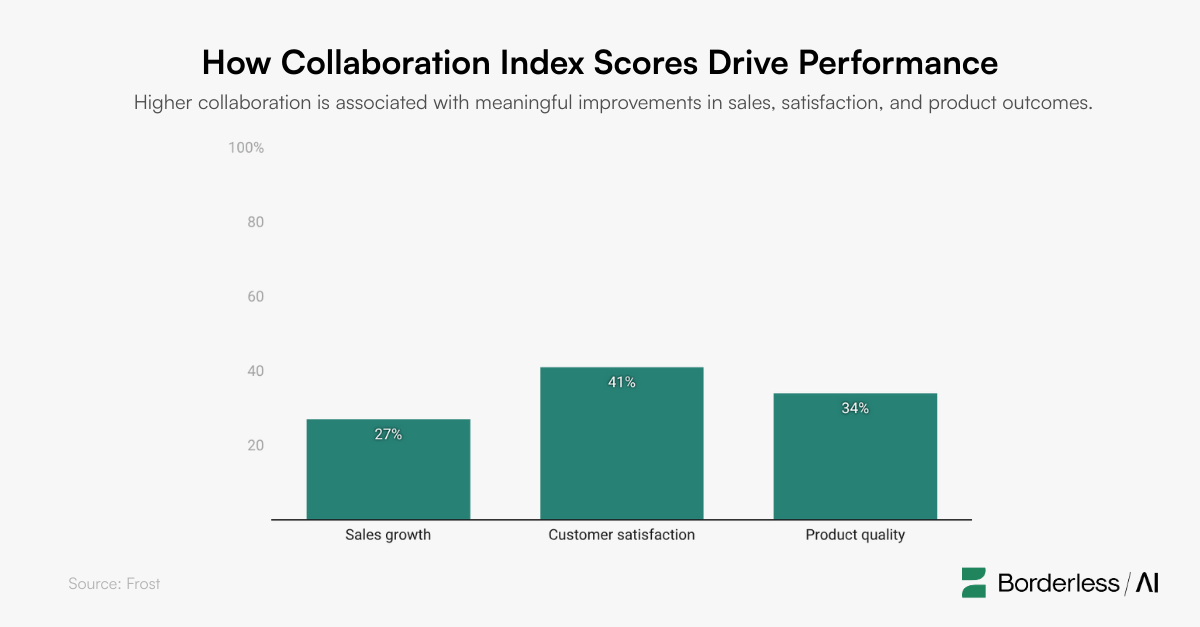
- A company’s collaboration index helps increase sales by about 27% and customer satisfaction ratings by 41%. It also improves product quality by more than 34%.
- Organizations with high levels of collaboration drag are 37% less likely to achieve their revenue goals. This shows how inefficiencies in collaboration can directly impact a company’s ability to hit its financial targets.
- Focusing on teamwork and collaboration within organizations can lead to a 30% increase in efficiency, especially when teams with different skills work together to achieve challenging goals
- Only 30% of U.S. employees strongly agree that their opinions count at work. However, if that percentage increases to 60%, companies could see a 27% decrease in turnover, 40% decrease in safety incidents, and 12% increase in productivity.

How AI and Digital Tools are Shaping Workplace Collaboration in 2026?
Technology is supposed to make team collaboration effortless. Now we have more collaboration tools than ever, from cloud-based tools to AI-driven solutions. The right technologies can streamline communication, improve productivity, and support seamless teamwork across remote and hybrid environments.
- 45% of workers feel more connected to their team because of using digital communication.
- Nearly 80% of workers use collaboration tools in their work today, a 44% increase in usage since 2021. Collaboration tools are becoming essential in the modern workplace, showing a significant shift towards digital collaboration.
- 95% of those surveyed say they plan to use business communication tools instead of in-person meetings, including 48% using email, 20% using mobile, 10% using desk phones, 8% using text messaging, and 8% using web meetings. The move towards business communication tools over in-person meetings is clearly a growing trend.

- Many workers spend a significant amount of time on digital communication platforms:
- 16% spend 21–25 hours per week
- 15% spend 16–20 hours
- 14% spend 11–15 hours
- 12% spend 6–10 hours
- Only 5% spend 31–35 hours per week.
- 2% use digital communication tools for more than 40 hours a week.

- 76% of people who primarily use some type of project management tool to communicate with coworkers report better internal communication.
- Employees using more than 10 apps report communication issues at a higher rate (54%) compared to those using fewer than 5 apps (34%). Managing too many tools can cause more communication breakdowns.
- Leaders who use AI in workplace report strong results:
- 85% complete tasks faster
- 84% are more productive
- 81% deliver higher quality work.
- The global collaboration software market is valued at USD 18.2 billion in 2024 and is expected to grow at a 7.7% CAGR between 2025 and 2034.
- The most effective communication tool varies by work setting:
- For on-site workers, 38% say mobile phones are most effective, followed by landline (22%) and Zoom (21%).
- For remote workers, 22% say Zoom is most effective, along with Google Chat (22%).
- For hybrid workers, 31% say Zoom is most effective, and 23% say Google Meet is most effective.

- 56% of respondents use video for communication, and 55% use audio. 42% use emojis, and 34% use GIFs as part of their communication.
How Are Hybrid Teams Collaborating in 2026?
Hybrid work is the new default for knowledge work. But "hybrid" covers a vast spectrum of approaches, and the teamwork challenges vary dramatically depending on how you've structured your model.
As employees balance remote and in-office work, new challenges and opportunities arise for maintaining communication, engagement, and productivity. These dynamics are reshaping team performance, requiring businesses to adapt their strategies for group collaboration across different work environments.
- 71% believe hybrid and remote work positively affects employee happiness, 58% say it improves employee retention, 57% report it enhances company-wide communication, and 52% feel it boosts team connectedness.

- 64% of hybrid workers feel they have open and honest two-way communication at their company.
- 74% of hybrid workers believe people make an effort to consult other staff when needed. Hybrid work encourages consultation and teamwork, ensuring employees actively seek input and support from their colleagues.
- 66% of hybrid workers feel that other departments collaborate well with them to get the job done.
How Are Remote Teams Collaborating Today?
Remote work collaboration has evolved far beyond emergency Zoom calls. By 2026, distributed teams have developed sophisticated practices, norms, and toolsets that rival (and often exceed) what traditional office environments deliver. As teams operate from different locations, technology and intentional collaboration strategies have become essential for maintaining productivity, engagement, and connection.
- 52% believe remote work has no impact or a positive impact on teamwork. While remote work isn’t seen as detrimental to teamwork, many employees still find that it has either no effect or a positive one on their ability to collaborate.
- 34% of employees feel more connected to the people they manage while working remotely, and 51% say it has had no impact on their connection.
- New research finds that fully remote workers have 33% fewer friends at work.
- 31% believe remote work has boosted the quality of their relationships with direct reports, while 54% say it’s stayed the same. When it comes to company leadership, 31% feel that remote work has improved connections, while 55% say the quality remains unchanged.

- 67% of remote workers feel they have open and honest two-way communication at their company.
- 80% of remote workers believe people make an effort to consult other staff when necessary. Group collaboration and consulting among employees remain a priority in remote settings, ensuring teams continue to work together effectively.
- 68% of remote workers feel other departments collaborate well with them to get the job done.
- Networking and inter-departmental collaboration take a hit with 100% remote work. One study shows remote work narrows employees’ networks, leading them to engage with fewer contacts inside and outside the organization.
- Overall, research shows that remote work caused the formal business groups and informal communities within Microsoft to become less connected and more siloed. The time employees spent collaborating with other groups dropped by about 25% compared to pre‑pandemic levels.
How Are In-Office Teams Collaborating in 2026?
Reports of the office's death have been greatly exaggerated. Physical workplaces still serve critical workplace collaboration functions when designed and used intentionally. In-office collaboration remains a cornerstone of team success, even as remote and hybrid work models grow. Face-to-face interaction fosters stronger relationships, faster decision-making, and higher levels of engagement.
- 72% of office workers believe there is open and honest two-way communication in their company.
- 77% of office workers say people at their workplace make an effort to consult with others when needed.
- 63% of office workers feel that other departments collaborate well with them to get the job done.
- In-person teams generate 15% to 20% more ideas than virtual teams. In-person interaction boosts creativity, allowing teams to generate more ideas and solutions compared to virtual settings.

- When engineering teams were asked to suggest new uses for an existing product, those meeting in person came up with more effective ideas that received higher rating, proving that brainstorming benefits from face-to-face interaction.
How Does Workplace Collaboration Vary by Region?
Employee engagement around the world varies significantly across regions: some areas see higher levels of engagement, while others face challenges with disengaged or actively disengaged employees:
Does Team Building Actually Work?
Teambuilding has a reputation problem often dismissed as forced fun or a waste of productive time. But the data tells a different story about what happens when organizations invest in intentional relationship-building and trust development. Team-building activities are essential for strengthening team dynamics and improving overall performance.
- After team-building activities, 63% of leaders notice an improvement in team communication, and 61% see a boost in team morale.
- 79% of leaders say company-wide meetings and town halls are helpful for strengthening team connections, 75% find employee training helpful, and 77% believe team-building exercises improve team dynamics.

- Conversations outside formal meetings are considered the most important factor for team success. If this is true, team building offers a great chance for your team to chat informally in an appropriate way, which can also boost team performance.
How Much Does Communication Impact Team Success?
You can't collaborate without communicating, yet most organizations treat communication as something that just happens naturally. Effective communication is the backbone of successful teamwork. Teams that communicate clearly and regularly are more productive, engaged, and capable of achieving their goals.
- 45% of employees believe that internal communication has a huge impact on their overall productivity.
- 74% of employees say that internal communication affects how much they feel part of the team, with some or great impact.
- 46% of people think communication in their company is either above average or excellent, marking a 5% improvement compared to last year. 9% rate communication as below average, and 3% think it’s poor.

- 53% of people say they’ve wasted time because of communication issues at work.
- 40% of people experience burnout, stress, and fatigue due to communication problems in their company.
- 9% of businesses have lost employees because of communication issues. That underlines the importance of improving internal communication to retain talent.
- 53% of employees say that more frequent (daily/weekly) communication makes them more familiar with company goals, objectives, and vision. Regular communication helps employees stay aligned with the company’s vision and goals, fostering engagement and loyalty.
- 16% of managers feel uncomfortable speaking face-to-face with employees. This may point to a need for additional communication training for managers to improve their interpersonal skills and boost team trust.
- 96% of business decision-makers and 95% of employees agree that effective communication is one of the most critical skills they will need for the upcoming year.
- 61% of employees say poor internal communication is a reason they would consider leaving their job, and 42% believe they could have avoided leaving with better communication from management.
- 69% of employees who are satisfied with internal communication plan to stay in their jobs for the next year, highlighting the importance of communication in employee retention.
Is Your Team Culture Helping or Hurting Collaboration?
A strong team culture is key to fostering group collaboration, trust, and engagement within the workplace. When teams share common values, goals, and a supportive environment, they’re more likely to perform at their best. You can implement the perfect tools, processes, and structures, but if the underlying culture doesn't support collaborative behaviors, none of it matters.
- 75% of workers prefer to interact with colleagues as they would with a friend. More than one-third also feel the same about interacting with external customers or partners. This shows that employees value personal connections at work, not just professional ones, which can improve workplace collaboration and relationships.
- A survey of 1,200 remote workers shows that the shift to full-time remote work is affecting social interactions, especially among younger generations. 39% of millennials and 21% of Gen Z workers say they have no friends in a remote work setting.

- There is a difference in views between men and women, with 41% of men saying remote work negatively impacts team collaboration, compared to 34% of women.

- Female employees who have a best friend at work (63%) are twice as likely to be fully engaged in their job compared to those without a best friend at work (29%). Having strong personal connections at work significantly boosts engagement.
- Among employees under 35, the percentage reporting they have a best friend at work has decreased from 25% to 20%, suggesting that team culture is changing
What Are the Biggest Team Collaboration Challenges Today?
Understanding what makes workplace collaboration work is important. Understanding what breaks it is essential. While collaboration in a workplace is essential for success, teams often face significant challenges in working together effectively.
- 86% of respondents believe that poor teamwork or ineffective communication leads to workplace failures, and 97% think that lack of team alignment impacts task and project outcomes.
- Here are the biggest struggles that remote and hybrid workers face:
- 28% feel they don’t get out enough
- 28% say they are overworking/working more
- 19% struggle with working across time zones
- 19% find it difficult to develop strong relationships at work
- 18% deal with technology issues
- 17% face non-work distractions
- 16% feel “invisible” to the boss
- 25% of fully remote employees report feeling lonely at work, compared to 16% of on-site workers, and 21% of hybrid workers.
- 46% of respondents feel stressed when messages are ignored for long periods of time, and 45% experience stress when they see their manager is typing a message. Other communication challenges that cause stress include:
- 42% stress over getting the right tone in digital messages
- 38% struggle to understand the tone of messages
- 36% are stressed by last-minute video calls from leadership
- 35% feel stressed when asked to turn off their camera during video calls

- Marketing employees who experience high collaboration drag are 15 times more likely to feel burned out and 9 times more likely to plan to leave the company in the next year.
- 60% of workers experience increased burnout because of digital communication compared to in-person interactions, with remote workers being particularly affected, as nearly 70% report burnout from digital interactions, compared to 56% of hybrid workers and 49% of on-site workers.
- With many digital communication tools available, 25% of workers say they always feel pressured to stay connected outside of working hours, while 35% often feel that pressure. Only 7% feel rarely pressured, and 10% feel never pressured.
- Over 40% of workers say poor communication reduces trust in both leadership and their team. Remote workers are more affected:
- 54% say poor communication harms trust in leadership
- 52% say it harms trust in their team
- For on-site workers, 43% say it impacts trust in leadership, and 38% say it affects trust in their team.
- 84% of marketers experience high levels of “collaboration drag”, which negatively impacts their performance and productivity.
- 11% of workers report that ineffective communication has no effect on them. For everyone else, poor communication affects:
- 49% in productivity
- 50% in job satisfaction
- 42% in stress levels

- 28% of employees say poor communication is the reason they cannot deliver work on time.
What's Next for Workplace Collaboration? The Trends Defining 2026
Workplace collaboration in 2026 looks radically different than it did just a few years ago and it's still evolving rapidly. Workplace collaboration continues to evolve as new technologies, work models, and employee expectations shape how teams work together. Understanding the latest trends in teamwork is crucial for staying competitive and fostering a productive work environment.
- A growing number of employees with remote‑capable jobs are working in hybrid arrangements, which are widely preferred for their balance between flexibility and collaboration. About 52% of remote‑capable employees in the U.S. work in a hybrid model, and even more prefer it over fully remote or on‑site work.
- Workplace collaboration is increasingly powered by digital tools and AI, with many organizations using cloud platforms and intelligent systems to support teamwork across different locations. By 2025, 91% of companies plan to use cloud-based collaboration tools and AI to improve communication and task workflows.

- 71% of leaders report that hybrid and remote work options have a positive impact on employee happiness and satisfaction.
- Meetings after 8 p.m. have increased by 16% year-over-year, showing how collaboration and work are increasingly extending outside traditional hours.
Building a More Collaborative Workplace in 2026 and Beyond
The workplace collaboration statistics of 2026 reveal a clear truth: how teams work together has become a defining competitive advantage. Organizations that invest in intentional collaboration practices, appropriate technology, and inclusive team cultures are measurably outperforming those that treat collaboration as something that happens automatically.
What these numbers make undeniably clear is that collaboration success depends on meeting teams where they actually work. For companies building international teams, the collaboration challenge is even more complex, requiring infrastructure that supports seamless teamwork across borders, time zones, and regulatory environments.
This is where services like Borderless AI become strategically important. As an employer of record service, Borderless AI enables organizations to build truly global teams while handling the complexity of international employment compliance. When you can hire the best talent anywhere without worrying about entity setup or local labor law, you can focus on what these statistics prove actually matters: building collaborative cultures, implementing effective communication practices, and creating environments where distributed teams thrive.
The future of work is about how well they collaborate, regardless of location. Organizations that understand this, backed by data rather than assumptions, are the ones building the high-performing teams that will define success in 2026 and beyond.
Reference List
“76% of Workers Say Collaboration Directly Impacts Company Culture: Here’s How.” Salesforce News, 16 Sept. 2021, www.salesforce.com/news/stories/collaboration-impact-on-company-culture/.
Alcala, Lori. “4 Trends in Workplace Communication.” CMSWire, 20 Jan. 2015, www.cmswire.com/cms/social-business/4-trends-in-workplace-communication-infographic-027762.php.
Andrews, Edmund. “Thinking inside the Box: Why Virtual Meetings Generate Fewer Ideas.” Stanford Graduate School of Business, 29 June 2022, www.gsb.stanford.edu/insights/thinking-inside-box-why-virtual-meetings-generate-fewer-ideas.
Ascalon, Anecia. “12 Team Building Statistics: We Surveyed Managers and Employees.” Team Building Hub, 20 Jan. 2022, teambuildinghub.com/blog/team-building-statistics/.
Barraclough, Dan. “Amazing Communication in the Workplace Statistics for 2020.” Expert Market US, 6 Feb. 2020, www.expertmarket.com/phone-systems/workplace-communication-statistics.
Beck, Randall, and Jim Harter. “Managers Account for 70% of Variance in Employee Engagement.” Gallup, 21 Apr. 2015, news.gallup.com/businessjournal/182792/managers-account-variance-employee-engagement.aspx.
“Breaking down the Infinite Workday.” Microsoft, 2025, www.microsoft.com/en-us/worklab/work-trend-index/breaking-down-infinite-workday.
Clark, Jennifer. “29 Statistics about Collaboration in the Workplace (2024).” Zoom, 16 May 2024, www.zoom.com/en/blog/workplace-collaboration-statistics/.
“Collaboration Software Market Size & Share .” Global Market Insights Inc., Dec. 2024, www.gminsights.com/industry-analysis/collaboration-software-market.
“Communication Statistics 2025 | Project.co.” Project.co, 2025, project.co/communication-statistics/.
Cross, Rob, et al. “Collaborative Overload.” Harvard Business Review, 20 Dec. 2016, hbr.org/2016/01/collaborative-overload.
Ferguson, Sharon, et al. ““Why Couldn’t We Do This More Often?”: Exploring the Feasibility of Virtual and Distributed Work in Product Design Engineering.” Research in Engineering Design, 20 June 2022, https://doi.org/10.1007/s00163-022-00391-2.
“Gartner Survey Reveals 84% of Marketers Report Experiencing High “Collaboration Drag” from Cross-Functional Work.” Gartner, 2024, www.gartner.com/en/newsroom/press-releases/2024-05-14-gartner-survey-reveals-eighty-four-percent-of-marketers-report-experiencing-high-collaboration-drag-from-cross-functional-work.
Gaskell, Adi. “New Study Finds That Collaboration Drives Workplace Performance.” Forbes, 22 June 2017, www.forbes.com/sites/adigaskell/2017/06/22/new-study-finds-that-collaboration-drives-workplace-performance/.
Gast, Arne, et al. “All about Teams: A New Approach to Organizational Transformation.” McKinsey & Company, 9 Dec. 2024, www.mckinsey.com/capabilities/people-and-organizational-performance/our-insights/all-about-teams-a-new-approach-to-organizational-transformation.
Gibbs, Michael, et al. “Work from Home & Productivity: Evidence from Personnel & Analytics Data on IT Professionals.” Journal of Political Economy Microeconomics, vol. 1, no. 1, 21 July 2022, www.journals.uchicago.edu/doi/full/10.1086/721803, https://doi.org/10.1086/721803.
Harter, Jim. “Employee Engagement vs. Employee Satisfaction and Organizational Culture.” Gallup, 13 Aug. 2022, www.gallup.com/workplace/236366/right-culture-not-employee-satisfaction.aspx.
Herway, Jake. How to Create a Culture of Psychological Safety. Gallup, 7 Dec. 2017, www.gallup.com/workplace/236198/create-culture-psychological-safety.aspx.
Hoory, Leeron. “The State of Workplace Communication in 2023 – Forbes Advisor.” Forbes, 8 Mar. 2023, www.forbes.com/advisor/business/digital-communication-workplace/.
“How to Improve Employee Engagement in the Workplace.” Gallup, 2025, www.gallup.com/workplace/285674/improve-employee-engagement-workplace.aspx.
Howington, Jessica. “Exploring the Impact of Remote Work on Mental Health and the Workplace.” FlexJobs , 16 June 2023, www.flexjobs.com/blog/post/exploring-the-impact-of-remote-work-on-mental-health-and-the-workplace.
“Hybrid Work.” Gallup, 2025, www.gallup.com/401384/indicator-hybrid-work.aspx.
“Hybrid Work Is Just Work. Are We Doing It Wrong?” Microsoft, 22 Sept. 2022, www.microsoft.com/en-us/worklab/work-trend-index/hybrid-work-is-just-work.
Jackson, Fresia, and Lisa Vandertogt. “Zooming In: What Data Reveals about Remote, Hybrid, and In-Office Work.” Culture Amp, 25 Sept. 2024, www.cultureamp.com/blog/remote-vs-hybrid-vs-in-office.
Jegatheeswaran, Tharani. “Delivering on the Promise of Digital Collaboration: Unlocking the Collaborative Power of Your Organisation .” Deloitte, 16 Jan. 2018, www.deloitte.com/au/en/services/consulting/blogs/delivering-on-promise-digital-collaboration.html.
“Job Satisfaction: Importance of Multi-Departmental Teamwork U.S. 2015.” Statista, Apr. 2016, www.statista.com/statistics/688726/job-satisfaction-importance-of-multi-departmental-teamwork-us/.
Managing across Distance in Today’s Economic Climate: The Value of Face-To-Face Communication. Harvard Business Review.
Mann, Annamarie. “Why We Need Best Friends at Work.” Gallup, 15 Jan. 2018, www.gallup.com/workplace/236213/why-need-best-friends-work.aspx.
New Study: 86 Percent of Employees Cite Lack of Collaboration for Workplace Failures. 2011.
Pentland, Alex. “The Hard Science of Teamwork.” Harvard Business Review, 20 Mar. 2012, hbr.org/2012/03/the-new-science-of-building-gr.
Rimol, Meghan. “Gartner Survey Reveals a 44% Rise in Workers’ Use of Collaboration Tools since 2019.” Gartner, 25 Aug. 2021, www.gartner.com/en/newsroom/press-releases/2021-08-23-gartner-survey-reveals-44-percent-rise-in-workers-use-of-collaboration-tools-since-2019.
Saayed, Mohamed Alaa. “Intercompany Collaboration Will Be Critical for Future Teams.” Frost & Sullivan, Apr. 2020, www.frost.com/growth-opportunity-news/intercompany-collaboration-will-be-critical-for-future-teams/.
SE, Staffbase. “Staffbase X USC Annenberg CCO Study.” Staffbase, 2024, insights.staffbase.com/tf/study/cco-study.
Solomon, Lou. “Two-Thirds of Managers Are Uncomfortable Communicating with Employees.” Harvard Business Review, 9 Mar. 2016, hbr.org/2016/03/two-thirds-of-managers-are-uncomfortable-communicating-with-employees.
Staffbase GmbH. “Communication Breakdown: 61% of Employees Unlikely to Stay in Their Job Cite Poor Communication among Top Reasons.” Prnewswire, 30 Sept. 2024, www.prnewswire.com/news-releases/communication-breakdown-61-of-employees-unlikely-to-stay-in-their-job-cite-poor-communication-among-top-reasons-302260487.html.
“State of the Global Workplace — Regional Data Summary.” Gallup, 2025, www.gallup.com/workplace/697850/state-of-the-global-workplace-regional-data.aspx.
“State of the Global Workplace Report.” Gallup, 2025, www.gallup.com/workplace/349484/state-of-the-global-workplace.aspx.
“Survey: Executives Want Flexible Work, Too.” Zoom, June 2022, www.zoom.com/en/resources/survey-executives-want-flexible-work-too/.
“The Social Economy: Unlocking Value and Productivity through Social Technologies.” McKinsey , 1 July 2012, www.mckinsey.com/industries/technology-media-and-telecommunications/our-insights/the-social-economy.
“Top 75+ Future of Work & Workplace Statistics 2025 .” Second Talent, 24 Sept. 2025, www.secondtalent.com/resources/future-of-work-workplace-statistics/.
Treadway, Clint. “New Survey Reveals Why Having Friends at Work Matters.” CPA Practice Advisor, 23 Aug. 2022, www.cpapracticeadvisor.com/2022/08/23/new-study-reveals-why-having-friends-at-work-matters/69777/.
“Workplace Friendships on the Decline.” Hrsource.org, 2024, www.hrsource.org/maimis/HRS/Articles/2024/04/23/Workplace_Friendships_on_the_Decline.aspx.
“Wrike.” Wrike, 2019, www.wrike.com/newsroom/happinessindexculture/.
Yang, Longqi, et al. “The Effects of Remote Work on Collaboration among Information Workers.” Nature Human Behaviour, 9 Sept. 2021, www.microsoft.com/en-us/research/publication/the-effects-of-remote-work-on-collaboration-among-information-workers/.
“Zoom X Morning Consult Report.” Zoom, 2024, click.zoom.com/global-morning-consult-collaboration-report.
.png)
.png)