


More companies are hiring in Thailand as they look for skilled talent across Southeast Asia. But employing someone locally means navigating Thai labor laws, payroll, taxes, benefits, and employment contracts.
That’s where an Employer of Record can help. An EOR lets you legally hire employees in Thailand without setting up your own local entity.
In this guide, we compare 9 of the best Employer of Record services in Thailand for 2026, including pricing, country coverage, compliance support, platform features, and overall fit.
You can also read our Thailand Hiring Guide for a deeper look at hiring and employment requirements in the country.
Why use an employer of record in Thailand
Thailand sits at the centre of Southeast Asia, which makes it a natural first hire for teams testing the region. Its strengths span electronics manufacturing, a growing digital economy, and a recovering tourism sector. A single Thai hire can double as a foothold for wider ASEAN expansion.
The economy is cooling, which shapes the hiring picture. The IMF projects growth to slow to 2.1% in 2025 and 1.6% in 2026 as exports weaken. A softer economy usually means more available talent over time.
Older market-size figures, such as foreign direct investment as a share of GDP, are worth refreshing before you build a business case on them.
The takeaway is simple. You reach a deep, skilled talent pool, but you take on Thai employment obligations the moment you hire. A local team also opens doors that remote contractors cannot, from on-the-ground client work to time-zone coverage across Asia.
What Thai compliance an EOR handles for you
The compliance details moved recently, so the EOR you pick needs to be current. Here are the rules that most affect your costs and contracts in 2026.
- Social security: A 2026 regulation raised the social security wage ceiling to THB 17,500, capping the employer's 5% contribution at THB 875 monthly.
- Maternity leave: The Ministry of Labour raised maternity leave from 98 to 120 days, effective 7 December 2025, with 60 days employer-paid.
- Spousal leave: The same amendment introduced 15 days of paid leave for an employee whose spouse gives birth.
- Payroll tax: Withholding tax (PND.1) is due by the 7th on paper, or the 15th when you file electronically.
An employer of record in Thailand keeps these current for you and remits everything on time. It also manages work permits for foreign hires and severance tied to tenure under the Labour Protection Act. If you want the full country breakdown, see our Thailand hiring guide.
The 9 best employer of record services in Thailand
Every provider below is verified as an active, standalone EOR as of September 2026. We note pricing, coverage, entity model, and G2 rating so you can match a provider to your situation.
Use the table for triage, then read the narratives. Country counts without entity quality still surprise buyers in diligence.
G2 scores and PEPM figures are from each vendor’s G2 product page and public pricing page as of September 2026. Chart cells link those primary sources directly; open vendor sections for narrative detail.
Borderless AI
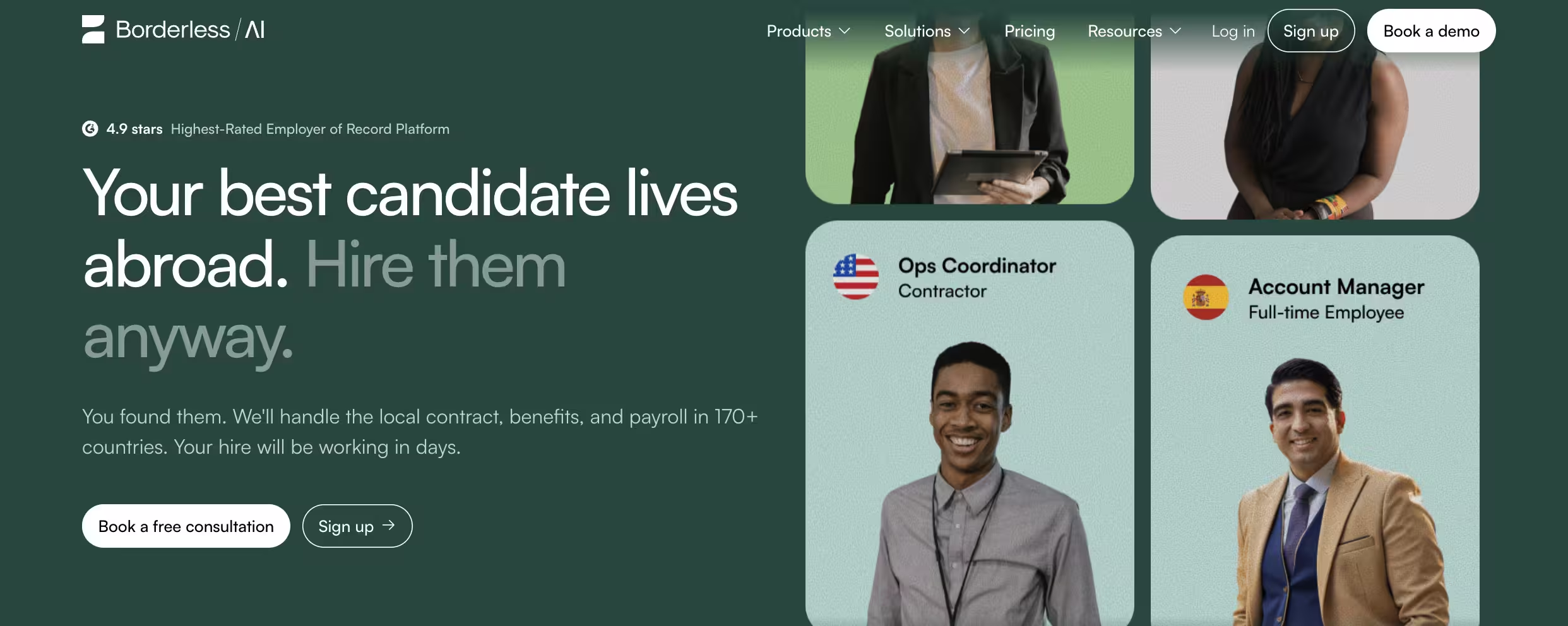
Why Use Borderless AI to hire in Taiwan?
Borderless AI is an AI-native EOR that hires and pays staff across 170+ countries without local entities. It suits teams that want fast onboarding and predictable payroll, from a first Thai hire to a distributed team of hundreds.
Pricing is transparent at $579 per employee per month with no hidden fees. Onboarding runs in five to seven business days, and payroll processes in three to five days against a 30-day market norm. Borderless AI owns its in-country entities, so the work is not outsourced to a third-party vendor.
It holds a 4.9/5 rating across 158 reviews on G2, the highest among major EOR providers, backed by a 24/7 in-house North American support team. The main trade-off is age: it is a newer platform with fewer legacy integrations than the incumbents.
The AI does real work rather than decorate a search bar. Its Contract Generator drafts compliant local contracts in minutes. Its compliance alerts flag labour-law changes, like Thailand's 2025 leave amendments before they catch you out.
Key Facts
Pros and Cons
Acclime Thailand

Why Use Acclime Thailand to hire in Taiwan?
Acclime Thailand is the Bangkok arm of the Acclime group, and it is built for companies that want deep local expertise. It fits buyers hiring mainly in Thailand and nearby APAC markets who value a dedicated account manager over a self-serve dashboard.
Acclime runs its own entities across roughly 18 APAC markets, including Singapore, Hong Kong, Vietnam, Malaysia, Indonesia, and China. It does not publish a standard per-employee rate, so expect a custom quote. There is no G2 profile to reference.
Onboarding typically takes one to two weeks. You trade broad global coverage and instant pricing for hands-on regional support and entity-transition help when you later set up your own company.
That entity-transition help is worth weighing if Thailand is a stepping stone rather than a permanent base. Acclime can move your staff onto your own company once headcount justifies it, without breaking payroll continuity.
Key Facts
Pros and Cons
Gloroots
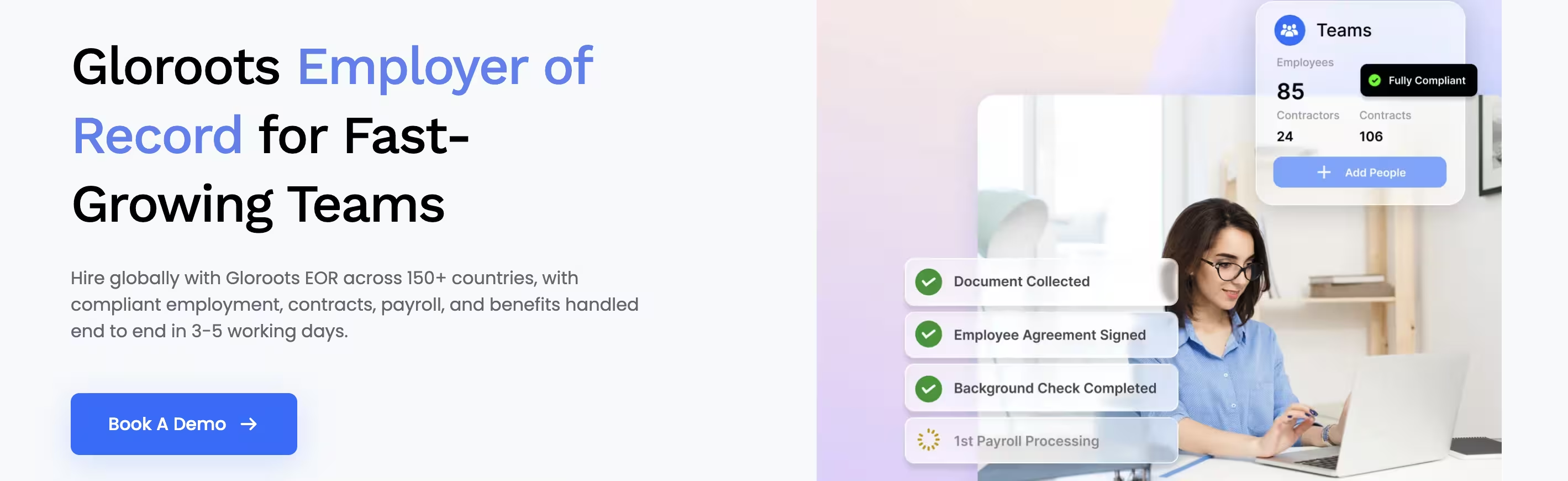
Why Use Gloroots to hire in Taiwan?
Gloroots is a value-focused EOR that covers 140+ countries with local experts handling Thai filings and multi-currency payroll. It works well for startups and scale-ups that want strong service without premium pricing.
Published pricing starts at $299 per employee per month, with contractor management from $29. It uses owned entities in core markets and a partner network elsewhere. On G2 it carries a 4.9/5 rating, though from about 25 reviews, so weigh that against larger providers.
Onboarding runs about one to two weeks, and support is demo-led at first. The pricing-to-feature ratio is the main reason buyers shortlist it.
Key Facts
Pros and Cons
Native Teams
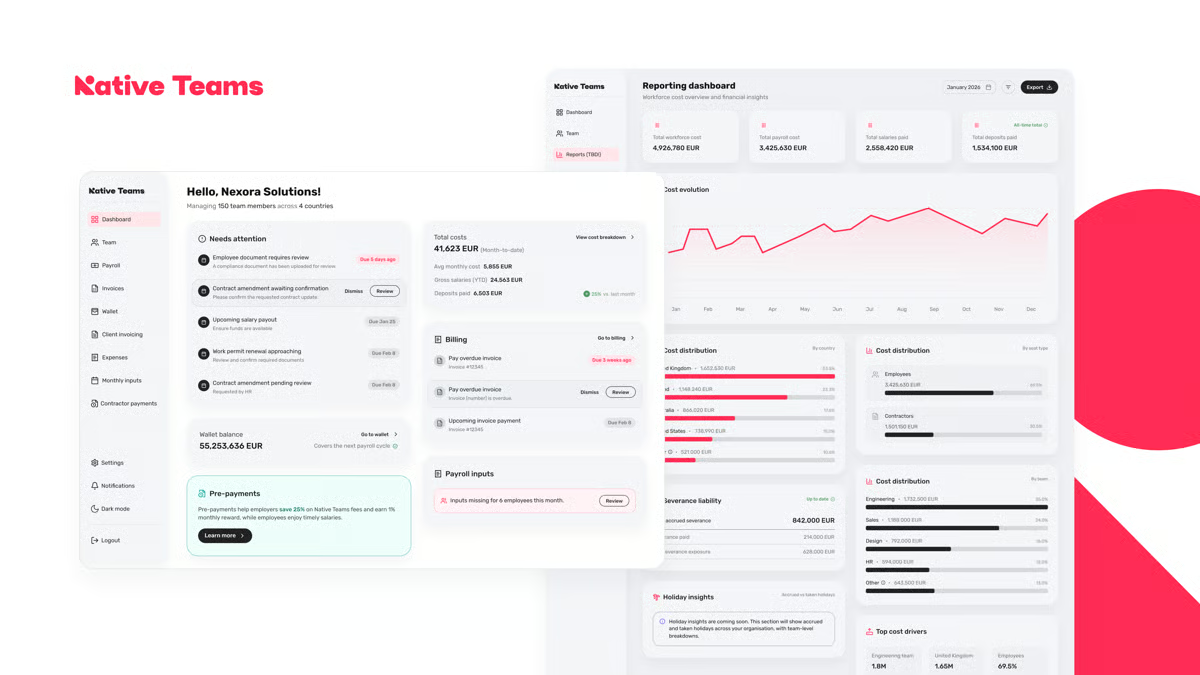
Why Use Native Teams to hire in Taiwan?
Native Teams is a budget-friendly EOR and payments platform aimed at smaller, EMEA-first teams and freelancer-heavy workforces. Its headline rate starts at $99 per employee per month, but that is tiered, and effective country rates commonly run higher.
The entity model is the detail to understand. Native Teams owns entities mainly across Europe, including the Balkans and Eastern Europe, and relies on partners elsewhere, so its Thai coverage is partner-supported. Country coverage is cited between 77 and 85 markets depending on the source.
It holds a 4.8/5 rating across 245 reviews on G2, with praise for affordable payments and mixed notes on coverage gaps outside Europe. Onboarding is quick at three to five days.
Read the $99 figure as a starting point, not a Thai quote. Once you layer in the tier for Thailand and partner-delivered coverage, the effective cost climbs, so model it against owned-entity providers.
Key Facts
Pros and Cons
A.R.E.E. Technology Solutions

Why Use A.R.E.E. Technology Solutions to hire in Taiwan?
A.R.E.E. Technology Solutions is a Thailand-only specialist that employs staff under its own Thai entity. It is a strong fit when your entire team is in Thailand and immigration support is a priority.
Its standout capability is visa and work-permit support, delivered by a bilingual Thai and English team. Pricing is not published, so plan for a custom quote, and there is no third-party G2 profile.
Onboarding is slower, at around two to three weeks. You give up global expansion options in exchange for focused local depth and competitive local pricing.
Key Facts
Pros and Cons
RLC Outsourcing

Why Use RLC Outsourcing to hire in Taiwan?
RLC Outsourcing is a Bangkok-based provider offering payroll, tax, and employment administration with a free initial consultation. It suits companies that want flexible, quote-based pricing and dedicated Thai compliance specialists.
Coverage extends across Thailand and into Southeast Asia, rather than Thailand alone. Pricing is custom with no public rate, and there is no G2 profile, so you rely on direct references.
Onboarding ranges from a few days to a few weeks depending on scope. The flexibility is the draw; the lack of transparent pricing and public reviews is the trade-off.
Key Facts
Pros and Cons
RecruitGo
Why Use RecruitGo to hire in Taiwan?
RecruitGo is a Dubai-headquartered EOR with real strength in Southeast Asia, making it a practical choice for offshore and nearshore teams in the region. It markets across 40+ countries using a mixed model of direct entities in core markets plus partners elsewhere.
Direct teams cover markets such as the Philippines, Indonesia, Malaysia, Thailand, Vietnam, and Singapore. Pricing is quote-based, and reviewers describe it as more reasonable than large global platforms.
RecruitGo now holds a 4.9/5 rating on G2, though from only about 11 reviews, so treat the score as directional. Support quality is its most-praised dimension. Onboarding runs about one to two weeks.
Because Thailand sits inside its owned-entity core, RecruitGo is stronger here than its 40-country footprint suggests. Coverage thins out once you move beyond those core Southeast Asian markets.
Key Facts
Pros and Cons
Hire With Columbus
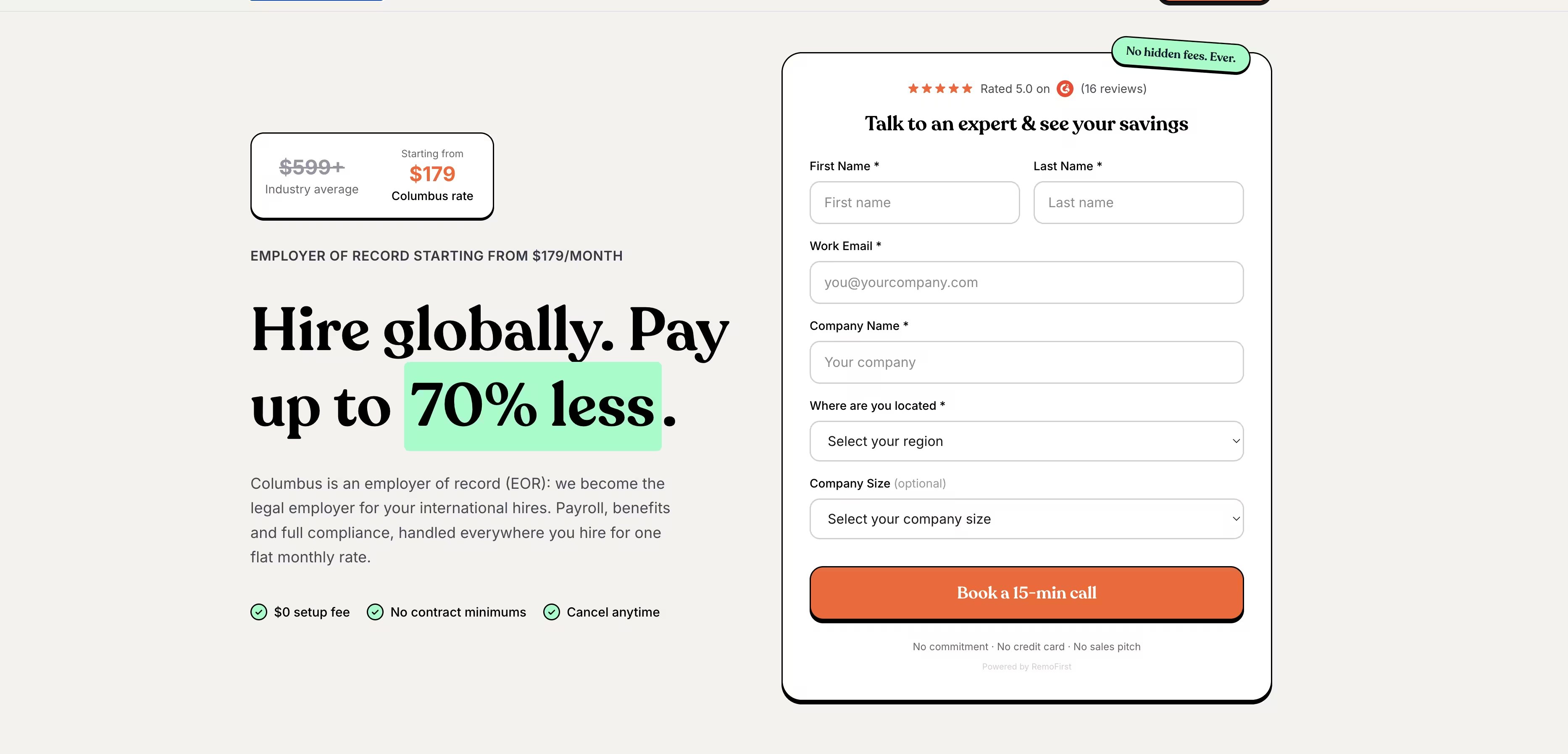
Why Use Hire With Columbus to hire in Taiwan?
Hire With Columbus is a Singapore-based platform, founded in 2025, that offers global hiring across 185+ countries. Pricing is a low flat rate from $179 per employee per month with no setup fees. It appeals to budget-conscious teams planning to scale beyond Thailand.
One point deserves emphasis. Columbus is a partner-model provider whose coverage is delivered through RemoFirst's infrastructure, so it does not own the entities behind your hires. That is worth knowing when compliance liability is a concern.
It carries a perfect 5.0/5 rating on G2, based on only about 16 reviews, so the sample is small. Onboarding takes roughly one to two weeks, and each client gets a dedicated account manager.
Key Facts
Pros and Cons
Rippling
Why Use Rippling to hire in Taiwan?
Rippling is a unified workforce platform combining HR, IT, and payroll with an EOR module. It makes most sense for companies already running Rippling for domestic operations that want international hiring in the same system.
Read the coverage and pricing carefully. EOR pricing starts around $599 per employee per month on top of the HR platform base fee. EOR coverage spans roughly 80 countries, while the 185+ figure reflects contractor reach.
In most EOR markets the legal employer is a local partner rather than Rippling itself. That makes it a partner-network EOR rather than an entity-owned one.
Rippling earns a 4.8/5 rating from over 13,000 reviews on G2, with top marks for automation and usability. The trade-offs are premium pricing and platform complexity for simple EOR needs.
Key Facts
Pros and Cons
How much do employer of record services in Thailand cost
Your total cost has two parts: the provider's fee and Thailand's statutory on-costs. Budget for both before you compare quotes.
Provider fees vary widely. Flat per-employee rates among the providers above run from about $99 to $599 per month, while several specialists quote custom pricing only. For a fuller breakdown of pricing models, see our guide to how much an EOR costs.
The statutory on-cost in Thailand is modest. The employer's social security contribution is 5% of wages, capped at THB 875 per month per employee from January 2026. There is no legal 13th-month bonus, so payroll math stays predictable.
Watch for two hidden costs. Some providers require a salary deposit or pre-funding, which ties up cash you could deploy elsewhere. Others quote in euros or dollars, so currency swings can quietly raise your Thai payroll bill.
Compared with opening a Thai entity, an EOR is usually cheaper for small teams. Entity setup carries legal fees, a capital requirement, and months of lead time before your first hire starts. Most companies only cross that break-even point once they reach a larger, permanent local headcount.
How we compared these providers
We scored every employer of record in Thailand on the same eight factors so the comparison stays consistent. Each factor maps to a real decision you will face when hiring in Thailand.
- Price: the published or quoted per-employee monthly cost
- Country coverage: how many markets the provider supports, and whether Thailand is owned or partner-run.
- Key features: payroll, contracts, benefits, and immigration support relevant to Thai hiring.
- G2 rating: the current score and review volume, weighted for sample size.
- Legal and compliance: command of Thai social security, severance, and the 2025 labour-law changes.
- Onboarding speed: how quickly a new hire reaches active payroll.
- Platform experience: the day-to-day usability of the dashboard for your team.
- Customer support: availability, responsiveness, and local expertise.
Expert tips for hiring in Thailand
A few practical points separate a smooth Thai hire from a costly one. Use these when you shortlist providers.
- Confirm local depth: ask whether the provider owns its Thai entity or uses a partner, since that affects compliance liability.
- Check bilingual support: Thai and English coverage reduces friction on contracts and employee questions.
- Prioritise immigration help: work-permit and visa support is essential when hiring foreign nationals.
- Model total cost: include currency conversion for euro-priced providers and any deposit requirements.
- Request references: especially for providers with thin or no public review history.
How to choose the right provider
Work through these steps in order to narrow the field quickly. The goal is a confident decision, not a long procurement cycle.
- Define your requirements, including headcount, timeline, and whether hires are Thai or foreign nationals.
- Review the comparison table above against those requirements.
- Evaluate each finalist's Thai compliance credentials and entity model.
- Book demos to test the platform and compare providers side by side.
- Verify support hours and local expertise for your time zone.
- Calculate total cost, including deposits, setup fees, and currency conversion.
- Check references, then start with a small pilot before scaling.
Why Borderless AI leads in Thailand
Borderless AI pairs owned in-country entities with AI that does real work, not a search bar dressed up as automation. Its Contract Generator drafts compliant local contracts in minutes. Its compliance tools flag changing labour laws, like Thailand's 2025 leave amendments, before they catch you out.
The proof is in the numbers. Borderless AI holds a 4.9/5 rating across 158 reviews on G2 as of September 2026. It also reports that more than 20% of its customers switched from another EOR provider. In August 2026, Telus chose Borderless AI to support its global, multi-currency payroll.
For Thailand specifically, that means onboarding in five to seven business days, three to five day payroll, and 24/7 in-house support. You can compare its EOR, global payroll, and contractor management products, or read how AI is reshaping the EOR space.
Frequently asked questions
Do I need a Thai entity to use an EOR?
No. The EOR is the legal employer in Thailand, so you can hire and pay staff without registering your own company. That is the core reason teams use one.
How fast can I hire in Thailand through an EOR?
It depends on the provider. Onboarding ranges from a few days with the fastest platforms to two or three weeks with some local specialists. Work permits for foreign nationals add time.
Can an EOR sponsor work permits for foreign hires?
Yes. Most providers in Thailand support visa and work-permit applications, and Thailand-only specialists treat immigration as a core service. Confirm this before you sign if you plan to relocate staff.
What is the difference between an EOR and a PEO?
An EOR is the full legal employer and needs no local entity from you. A PEO shares employment duties and requires you to have your own Thai entity. Our EOR versus PEO guide covers the detail.
Can I move an EOR employee to my own entity later?
Yes. When your Thai headcount justifies a local company, you can register an entity and transfer staff to it. Providers with entity-transition support, such as Acclime, can help you manage that handover without disrupting payroll.
Does the provider own its Thai entity or use a partner?
This varies, and it matters for compliance liability. Borderless AI and Acclime own their entities, while Hire With Columbus and Rippling deliver Thai coverage through partners. Ask directly, and check our country hiring guides for context.
Is an EOR compliant with Thai labour law?
Yes, that is the whole point of using one. A reputable EOR issues contracts under the Labour Protection Act and remits social security and tax on schedule. It also applies the 2025 leave rules and 2026 social security changes for you automatically.
Which provider suits a first hire in Thailand?
It depends on your plans. If you expect to hire beyond Thailand, a broad-coverage platform like Borderless AI fits well. If your team stays local, a Thailand-only specialist may serve you better.
Final thoughts
Thailand's service sector keeps expanding, and its labour market is tight but accessible through the right partner. The complexity is real: a 5% social security contribution, mandatory severance scales, and Foreign Business Act limits on foreign ownership.
The right EOR in Thailand removes that friction so you can hire and pay a Thai team without opening an entity. If speed, transparent pricing, and owned entities matter to you, Borderless AI is the strongest fit, and switching providers is straightforward.
Ready to see it work? Experience Borderless AI with a live demo.