



Paying an international employee from the U.S. involves far more than sending a wire transfer. Every country you hire in brings its own tax codes, labor laws, payroll frequencies, and mandatory benefits — and you're accountable in all of them. Get it wrong, and you face fines, back-pay claims, or worse.
The good news: the process is far more manageable than it was even five years ago. Whether you're hiring your first remote developer in Portugal or scaling a team across Southeast Asia, there's a clear path to paying international employees compliantly, on time, and without setting up foreign offices. This guide breaks down every method available to U.S. employers, the tax obligations you need to know, how to handle currency and compliance, and where AI-powered payroll platforms are eliminating the manual burden entirely.
Why paying international employees is more complex than domestic payroll
The short answer: every country is its own regulatory universe, and you're accountable in all of them.
When you hire domestically, you deal with one set of federal tax rules and (at most) 50 state variations. When you hire internationally, every employee's home country adds a new layer of employment law, tax withholding requirements, social security contributions, and mandatory benefits — a full international payroll challenge — from statutory pension contributions in Germany (roughly 9.3% employer share) to 13th-month salary requirements across much of Latin America.
As a U.S. employer, you face dual obligations. You still have IRS reporting requirements for payments to foreign nationals, and you're simultaneously responsible for complying with the employee's local labor laws. Misclassifying an employee as a contractor — a risk explored in depth in our employee vs. contractor classification guide — can trigger back-pay, penalties, and lawsuits. Establishing a "permanent establishment" in a country — even unintentionally — can create corporate tax obligations you didn't plan for.
None of this is unsolvable. But it does mean you can't treat international payroll like domestic payroll with a currency conversion tacked on. The right approach depends on your team size, the countries you're hiring in, and how much compliance infrastructure you want to manage yourself.
5 ways to pay international employees from the US
There's no single right way to pay international employees. The best method depends on where your employees are located, how many you're hiring, and whether you already have legal entities abroad. Here are five approaches, ranked from most accessible to most infrastructure-heavy.
1. Use an Employer of Record (EOR)
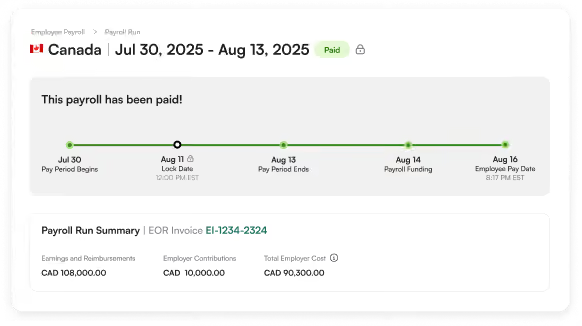
An Employer of Record becomes the legal employer of your international hire in their home country. You manage the employee's day-to-day work; the EOR handles payroll, tax withholding, benefits, employment contracts, and local compliance.
This is the fastest path to compliant hiring international employees for most companies. There's no need to register a foreign entity — onboarding typically takes days, not months. AI-native EOR platforms have compressed this further, with some completing onboarding in as little as 5 to 7 business days compared to the industry average of 30 days.
Best for: Companies hiring 1 to 50 employees in a new country, or those expanding into multiple countries simultaneously.
Typical cost: A flat monthly fee per employee, generally ranging from $199 to $599 per month depending on the country and provider. Some legacy providers also require security deposits or salary pre-funding — a practice that ties up your working capital unnecessarily.
Key advantage: You get compliant, on-time payroll in 170+ countries without building any legal infrastructure. The EOR owns the entity, manages the employment relationship, and absorbs the compliance burden.
2. Set up a foreign legal entity
If you're hiring a large team in a single country, establishing your own subsidiary or branch office gives you full control. You handle payroll, benefits, and culture directly — but you also own every compliance obligation.
What's involved: Registering a legal entity typically costs $20,000 to $100,000 or more and takes 3 to 6 months. Ongoing requirements include local accounting, annual filings, registered agents, and a deep understanding of that country's employment law. You'll also need local bank accounts and a payroll provider or in-house payroll team.
Best for: Companies with 15+ employees in a single country and a long-term commitment to that market.
The trade-off: Full control comes with full responsibility. For most companies expanding into their first or second international market, this approach is overkill.
3. Partner with a Professional Employer Organization (PEO)
A PEO operates on a co-employment model — you share employer responsibilities with the PEO. This works well for domestic expansion in the U.S., where PEOs are well-established and widely used.
Internationally, PEOs are far less common. Some providers offer international PEO services, but coverage is inconsistent, and the co-employment model doesn't translate cleanly to every country's labor framework. In many jurisdictions, the legal structure of co-employment simply doesn't exist.
Best for: Companies that already use a domestic PEO and want to explore limited international expansion through the same provider.
The limitation: For true global hiring, an EOR is a more reliable and legally clear option than an international PEO.
4. Hire as an independent contractor
This is the simplest option on paper: classify the worker as an independent contractor, agree on a fee, and pay them directly via wire transfer, Wise, or a contractor payment platform.
But simplicity comes with serious risk. Most countries have strict legal tests to distinguish employees from contractors — the ABC test, the economic reality test, or country-specific frameworks. If your "contractor" works set hours, uses your tools, and reports to your manager, they're likely an employee under local law. Misclassification can result in back-pay for benefits, tax penalties, and legal action.
When it works: Genuinely project-based, autonomous work with a defined scope and timeline. The contractor controls how and when the work is done, works with multiple clients, and provides their own equipment.
U.S. tax requirement: Collect a W-8BEN from each international contractor for IRS reporting purposes. This form certifies their foreign status and may determine whether withholding applies.
The bottom line: If the working relationship looks like employment, treat it like employment. The cost of misclassification is always higher than the cost of doing it right.
5. Use a global payroll provider
A global payroll provider consolidates payroll processing across multiple countries into a single platform. It handles multi-currency payments, local tax calculations, statutory deductions, and unified reporting.
The catch: global payroll providers typically require you to already have legal entities in each country where you're paying employees. They process payroll through your entities — they don't replace them.
Best for: Mid-to-large companies with established entities in multiple countries that want to streamline payroll operations and reporting.
The distinction: If you don't already have foreign entities, you need an EOR first. Some platforms offer both EOR and global vs. local payroll options, which lets you start with EOR and transition to your own entities as your team in a given country grows.
U.S. tax obligations when paying foreign employees
This is the section most guides skip or skim. Your IRS obligations when paying international employees are real, but they're also more straightforward than most people expect.
The baseline rule: Foreign employees performing work entirely outside the United States are generally not subject to U.S. federal income tax withholding. You don't withhold FICA (Social Security and Medicare) taxes for employees working abroad unless they're U.S. citizens or resident aliens.
What you do need to handle:
- W-8BEN collection. Every foreign employee or contractor should submit a W-8BEN form, which certifies their foreign status and determines whether any U.S. tax withholding applies to their payments. (See IRS Publication 515 for full withholding rules.)
- 1042-S filing. If you make certain payments to foreign persons that are subject to withholding (such as U.S.-source income), you must file Form 1042-S annually.
- FATCA compliance. The Foreign Account Tax Compliance Act may impose additional reporting requirements for payments to foreign nationals, depending on the payment type and amounts.
- Totalization agreements. The U.S. has bilateral social security totalization agreements with over 30 countries, including Canada, the UK, Germany, Japan, and Australia. These agreements prevent double taxation — your employee won't pay social security taxes in both the U.S. and their home country. Check the SSA's list of totalization agreement countries to confirm coverage.
- State-level nexus. If a foreign employee manages U.S.-based operations or generates U.S. revenue, your company may trigger state-level tax nexus in certain jurisdictions. This is a nuanced area — consult a cross-border tax specialist if your international employees have U.S.-facing responsibilities.
The key takeaway: your tax obligations are primarily about reporting, not withholding. An EOR handles most of this automatically on your behalf, including W-8BEN collection and local tax compliance in the employee's country.
How to handle currency, exchange rates, and payment timing
Currency is one of those details that seems minor until it isn't. Get it wrong, and you're either violating local labor laws or losing money on every pay cycle.
Pay in local currency. Most countries require that employees receive their salary in the local currency. Paying a German employee in USD, for example, can violate German labor law. Even where it's technically permitted, employees absorb unfavorable exchange rates and bank conversion fees — which erodes trust and satisfaction.
Exchange rate strategy. FX rates fluctuate daily. You have two options: lock in a rate at the beginning of each pay cycle (more predictable for budgeting) or pay at the spot rate on the date of transfer (simpler but less predictable). Most EOR and global payroll platforms handle currency conversion automatically, applying mid-market rates and absorbing the operational complexity. Some platforms support 90+ currencies, which matters when you're scaling across regions.
Payment frequency. Don't assume monthly. While monthly payroll is the global default, some countries require bi-weekly or weekly payments. Brazil mandates two payments per month. Several countries in Latin America and Southern Europe require 13th-month (and sometimes 14th-month) salary payments — these are mandatory, not bonuses, and you need to budget for them from day one.
Wire transfer costs. If you're paying via SWIFT wire transfers, expect 3 to 5 business days for delivery and $25 to $50 in fees per transaction. (For context on handling retroactive pay corrections across borders, this adds further complexity.). Modern payroll platforms eliminate this by processing payments in bulk through local banking rails, cutting delivery time to days, not weeks.
How to stay compliant with local labor laws
Compliance isn't a one-time checklist — it's an ongoing responsibility that changes as regulations evolve. Here's what U.S. employers need to track when paying international employees.
Mandatory benefits. Every country defines its own set of required employee benefits. These commonly include healthcare, pension contributions, paid leave (often 20 to 30 days annually in Europe), parental leave, and severance pay. Employer-side social contributions can add 15% to 45% on top of gross salary, depending on the country.
Employment contracts. U.S.-style at-will employment doesn't exist in most countries. You'll need written employment contracts that comply with local requirements, including notice periods, termination conditions, non-compete terms, and role-specific provisions. In many jurisdictions, verbal agreements or informal offer letters are either insufficient or unenforceable.
Permanent establishment risk. Hiring an employee in a country can, in some cases, create a "permanent establishment" — a taxable business presence that triggers corporate tax obligations in that country. This is especially relevant if the employee has authority to sign contracts, manages a local office, or generates significant local revenue. Structuring the hire through an EOR avoids PE risk because the EOR — not your company — is the legal employer.
Data privacy. Payroll involves sensitive personal data. In the EU, GDPR governs how you collect, store, and process employee information. Other regions have their own data protection frameworks (Brazil's LGPD, Canada's PIPEDA). Non-compliance can result in substantial fines — up to 4% of global annual revenue under GDPR.
IP protection. Employment contracts must include locally compliant intellectual property assignment clauses. IP ownership rules vary by country, and a clause that's enforceable in the U.S. may not hold up in Germany or India. Getting this right at the contract stage is far cheaper than litigating it later.
The through-line here: compliance scales with the number of countries you operate in, and it changes as laws change. AI-powered platforms are increasingly able to monitor regulatory updates in real time and flag changes before they affect your payroll — turning compliance from a reactive scramble into a proactive system.
How AI is changing international payroll
Traditional international payroll is slow and heavily manual — and that combination makes errors almost inevitable. HR teams track regulatory changes across spreadsheets while contracts get drafted from templates that may be months out of date. Payment processing still depends on banking infrastructure designed for domestic transactions.
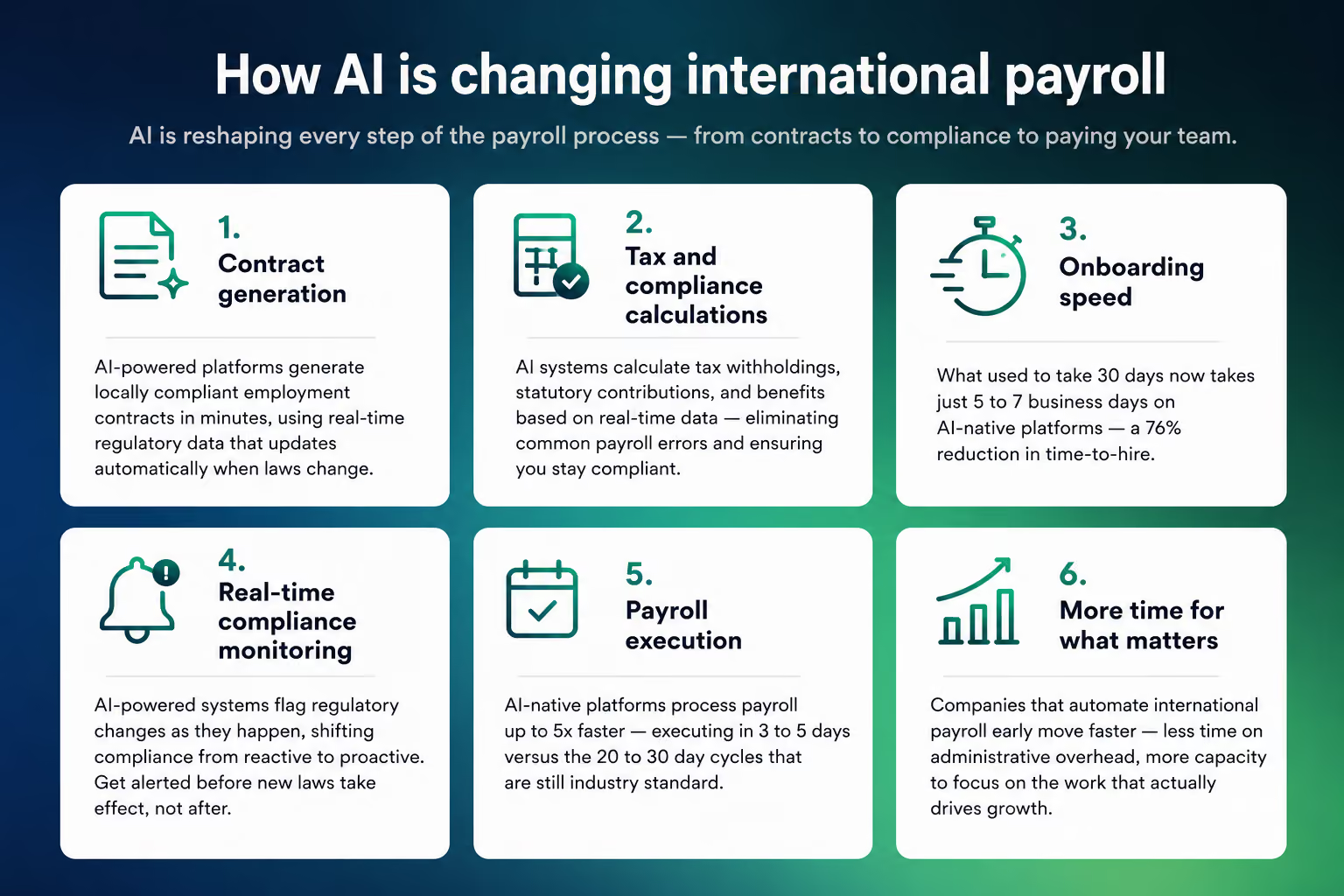
AI is reshaping every step of that process.
Contract generation. AI-powered platforms can generate locally compliant employment contracts in minutes, pulling from current regulatory databases rather than static templates. When labor laws change — a new minimum wage in Mexico, updated leave policies in France — the contract engine updates automatically.
Tax and compliance calculations. Instead of relying on manual research or outsourced specialists, AI systems calculate tax withholdings, statutory contributions, and benefit entitlements based on real-time regulatory data. This eliminates the most common payroll errors: incorrect tax withholdings, missed mandatory contributions, and late payments.
Onboarding speed. What used to take 30 days — entity verification, document collection, compliance review, contract generation — now takes as little as 5 to 7 business days on AI-native platforms. That's a 76% reduction in time-to-hire, which matters when you're competing for talent in tight labor markets.
Real-time compliance monitoring. Rather than discovering a regulatory change after it affects payroll, AI-powered systems flag changes as they happen. This shifts compliance from reactive to proactive — your team gets alerted before a new labor law takes effect, not after you've violated it.
Payroll execution. AI-native platforms process payroll up to 5x faster than traditional providers — executing in 3 to 5 days versus the 20 to 30 day cycles that are still industry standard. Faster payroll means employees are paid on time, every time, and finance teams spend less time chasing payment confirmations.
Companies that automate international payroll early move faster — less time on administrative overhead, more capacity to focus on the work that actually drives growth.
Why Borderless AI for paying international employees
If you're evaluating how to pay international employees, Borderless AI was built specifically for this challenge.
Borderless AI is the world's first AI-native Employer of Record and global payroll platform. The platform covers 170+ countries and 90+ currencies, with 100% company-owned entities — no outsourced third-party vendors managing your employees' experience.
What sets it apart:
- No salary deposits or pre-funding. Most legacy EOR providers require security deposits that lock up your working capital. Borderless AI doesn't.
- 3 to 5 day payroll execution. Compared to the 20 to 30 day industry norm, that's up to 5x faster payroll processing.
- AI-powered onboarding. Compliant employment contracts generated in minutes, not weeks. Benefits enrollment, compliance checks, and document collection happen through intelligent automation.
- 100% on-time payments. Every payroll, every country, every cycle.
- 24/7 in-house support. North American-based team — no outsourced call centers. Rated 4.9 out of 5 on G2.
- Flat-rate, transparent pricing. No hidden fees, no surprise invoices. Customers report 40% cost savings per hire compared to legacy providers.
Whether you're hiring your first international employee or managing a distributed team across dozens of countries, Borderless AI handles payroll, compliance, contracts, and benefits so you can focus on building your team.
Get started with Borderless AI | Explore global payroll
FAQs
Can a US company pay foreign employees?
Yes. U.S. companies can legally pay foreign employees, but they must comply with the employee's local labor laws, tax regulations, and benefits requirements. The simplest compliant path is through an Employer of Record, which handles all legal and payroll obligations in the employee's country.
What is the best way to pay international contractors?
Pay international contractors through a dedicated contractor payment platform or direct wire transfer, and collect a W-8BEN form for IRS reporting. Make sure the working relationship genuinely qualifies as independent contracting under the worker's local laws — misclassification penalties can be severe.
Do I need to collect a W-8BEN from international workers?
Yes. Any foreign individual receiving payments from a U.S. company should submit a W-8BEN form, which certifies their foreign tax status and determines whether U.S. tax withholding applies.
What is permanent establishment risk?
Permanent establishment (PE) risk is the possibility that hiring or operating in a foreign country creates a taxable business presence there, triggering corporate tax obligations. Using an EOR avoids PE risk because the EOR — not your company — is the legal employer in that country.
Should I pay international employees in USD or local currency?
Pay in local currency. Most countries legally require it, and even where USD is permitted, employees absorb unfavorable exchange rates and fees. EOR and global payroll platforms handle currency conversion automatically.
How long does it take to set up international payroll?
It depends on your approach. Setting up a foreign entity takes 3 to 6 months. Using an EOR, you can have international payroll running in as little as 5 to 7 business days, including compliant contracts and benefits enrollment.