



Are employees getting the feedback they need to grow, or are organizations still relying on outdated review cycles that no longer work? In 2026, employee feedback has become one of the strongest predictors of engagement, performance, and retention. As hybrid work stabilizes and expectations shift, feedback is no longer something employees wait for once a year. It is something they expect consistently.
Organizations that treat feedback as an ongoing process see measurable results, from higher productivity to lower turnover. Those who don’t often struggle with disengagement, misalignment, and talent loss. The statistics below show how employee feedback is changing, why it matters more than ever, and where many companies still fall short.
What This Statistic Page Is About:
This statistic page gathers current research regarding how organizations deliver and react to employee feedback in 2026. The research provides insight into how frequently employee feedback is provided, how useful employee feedback is to employees, and the relationship that exists between employee feedback and engagement, leadership effectiveness, and business outcomes.
The purpose of this page is to provide a detailed and data-driven understanding of the positive impact of employee feedback systems and the areas where there is an opportunity for growth and development.
Research Summary:
These employee feedback statistics were compiled from large-scale workforce surveys, longitudinal research studies, and organizational reports published by Gallup, Gallup and Workhuman, Zenger Folkman, PwC, SHRM, and other workplace research institutions.
Priority was given to primary research reports with clearly defined samples and methodologies, particularly those reflecting hybrid and remote work environments.
This data is intended for HR leaders, people managers, executives, and organizations building evidence-based feedback systems that support performance and retention.
Key Employee Feedback Statistics
- 96% of employees believe regular feedback helps them improve, yet nearly half of employees say they don't receive feedback at the rate they want.
- 65% of employees say they want more feedback than they currently receive, highlighting a significant gap between employee needs and current feedback practices.
- Only 1 in 5 employees receives feedback on a weekly basis, even though about half of managers believe they give feedback often, revealing a major perception gap.
- Four in ten employees become actively disengaged when they receive little or no feedback, demonstrating the direct link between feedback frequency and engagement.
- Employees who receive daily feedback from their manager are 3.6 times more likely to feel motivated to excel than those who receive annual feedback.
- 80% of employees who received meaningful feedback in the past week are fully engaged, regardless of whether they work remotely, hybrid, or in person.
- 66% of employees say they would likely leave their role if they do not feel appreciated by their manager.
- Employees who strongly agree they receive valuable performance feedback are 48% less likely to be actively job searching or considering other opportunities.
Why Does Employee Feedback Matter?
Employee feedback can greatly influence an employee’s feelings of connection with their job, manager, and employer.
Feedback that is provided in a timely manner and clearly states expectations allows employees to be aware of what they need to do to meet those expectations, enables them to receive recognition for their efforts, and increases the likelihood of staying engaged.
When feedback is absent, late, or unclear, motivation will drop, and overall performance will decrease as employees become disconnected from their jobs and start looking elsewhere.
- 96% of employees believe regular feedback helps them improve, showing near universal demand for ongoing feedback. This near-universal demand suggests that feedback isn't a nice-to-have but a fundamental workplace expectation.
- 65% of employees say they want more feedback than they currently receive. This gap between what employees want and what they actually receive points to a widespread communication breakdown between managers and their teams.
- Four in ten employees become actively disengaged when they receive little or no feedback, making managerial silence one of the biggest drivers of lost motivation.
- 46% of employees say they do not get feedback from their manager at the rate they want. Nearly half the workforce feels they're operating without enough guidance to do their best work.
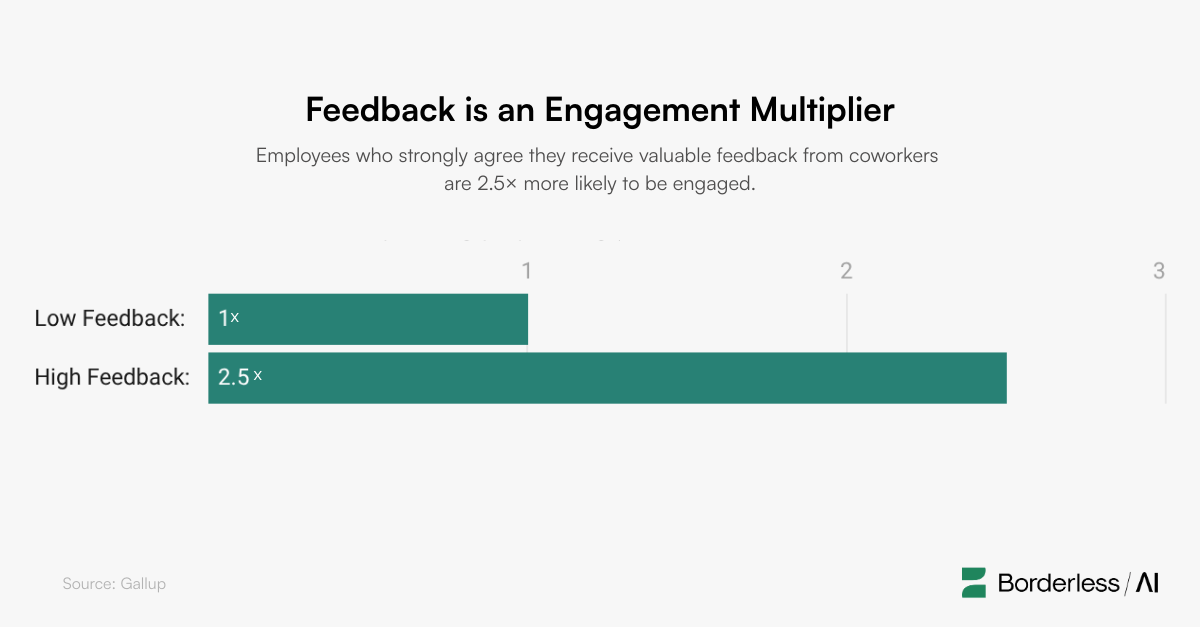
- Employees who strongly agree that they get valuable feedback from coworkers are 2.5 times as likely to be engaged.
- Recognition and appreciation are also closely tied to retention. 66% of employees say they would likely leave their role if they do not feel appreciated by their manager.
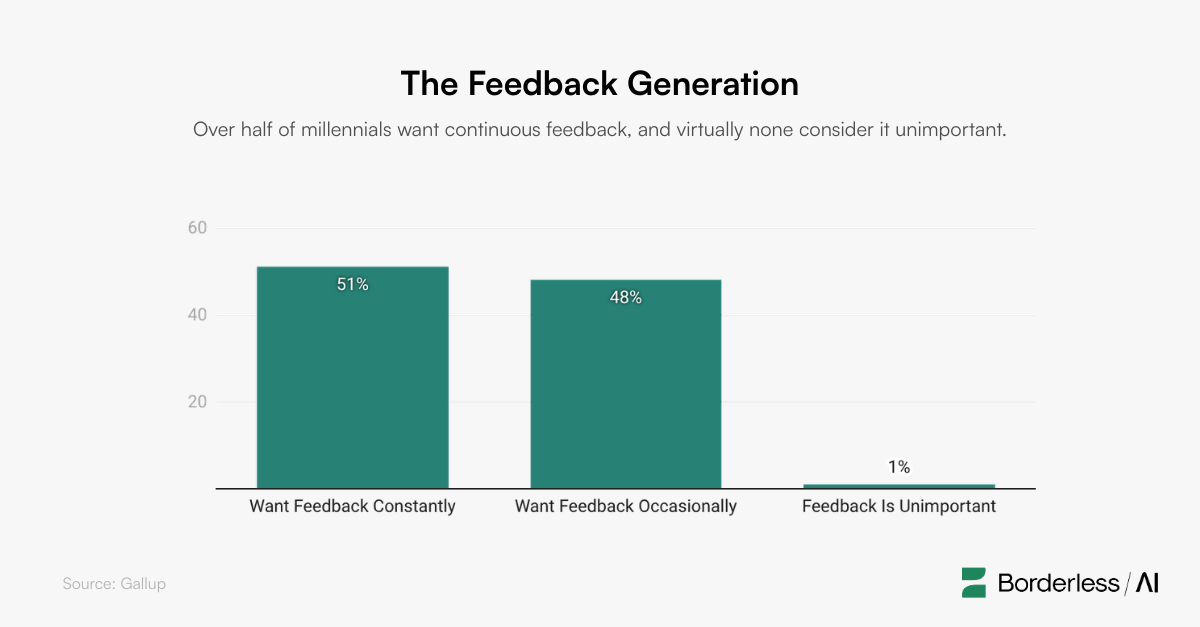
- Among millennials, the appetite for feedback is especially strong. 51% of millennials want feedback constantly, while only 1% say feedback is unimportant.
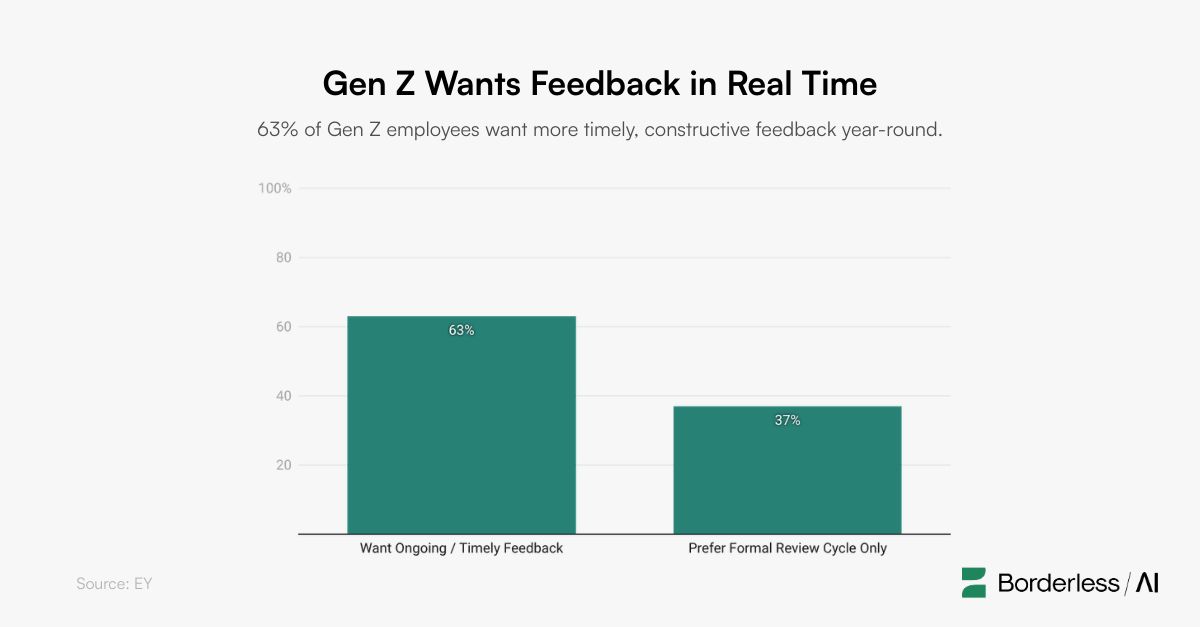
- 63% of Gen Z employees want more timely and constructive feedback throughout the year, not just during formal reviews.
- That openness to feedback is nearly universal among younger workers. 97% of Gen Z workers say they are open to receiving feedback regularly or after projects, signaling strong expectations for continuous input.
How Often Do Employees Want Feedback?
The timing of feedback matters just as much as the message itself. When employees wait weeks or months to hear how they’re doing, feedback often feels disconnected from the work they remember doing. More regular feedback keeps employees focused on what actually matters right now, instead of correcting things after the fact.
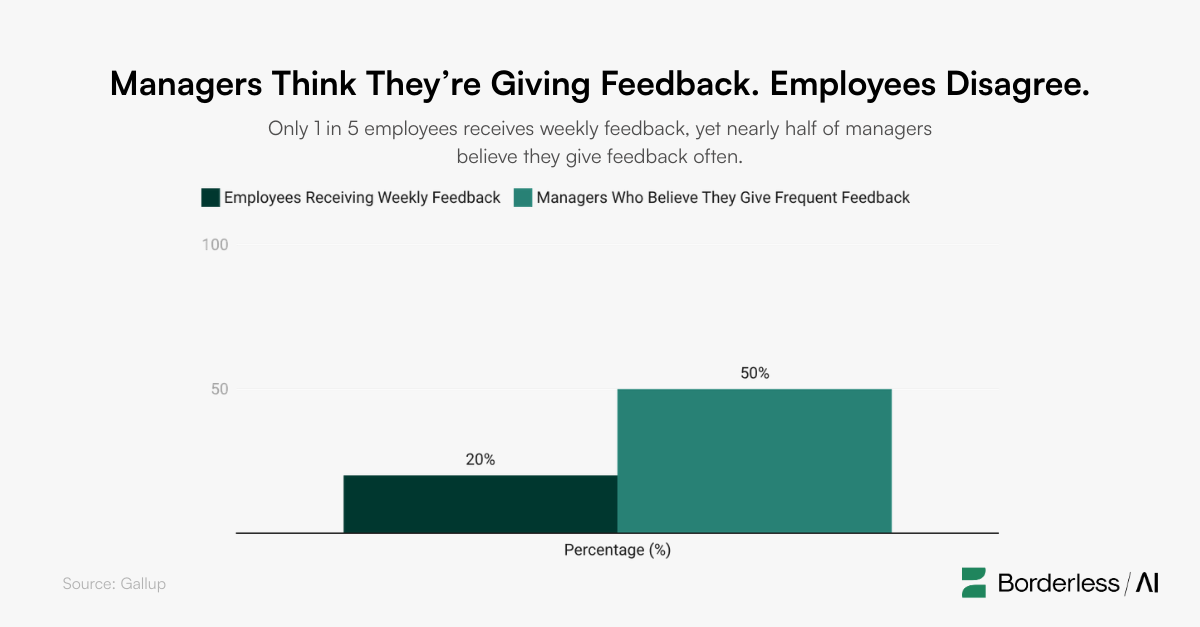
- Only 1 in 5 employees receives feedback on a weekly basis, even though about half of managers believe they give feedback often. This gap suggests many managers significantly overestimate how often they're actually checking in with their teams.
- Nearly half of employees say they get manager feedback only a few times a year or less, meaning most workers go weeks or even months without meaningful input on their performance.
- Employees who receive daily feedback from their manager are 3.6 times more likely to feel motivated to excel than those who receive annual feedback. The more frequent the feedback loop, the stronger the drive to perform.
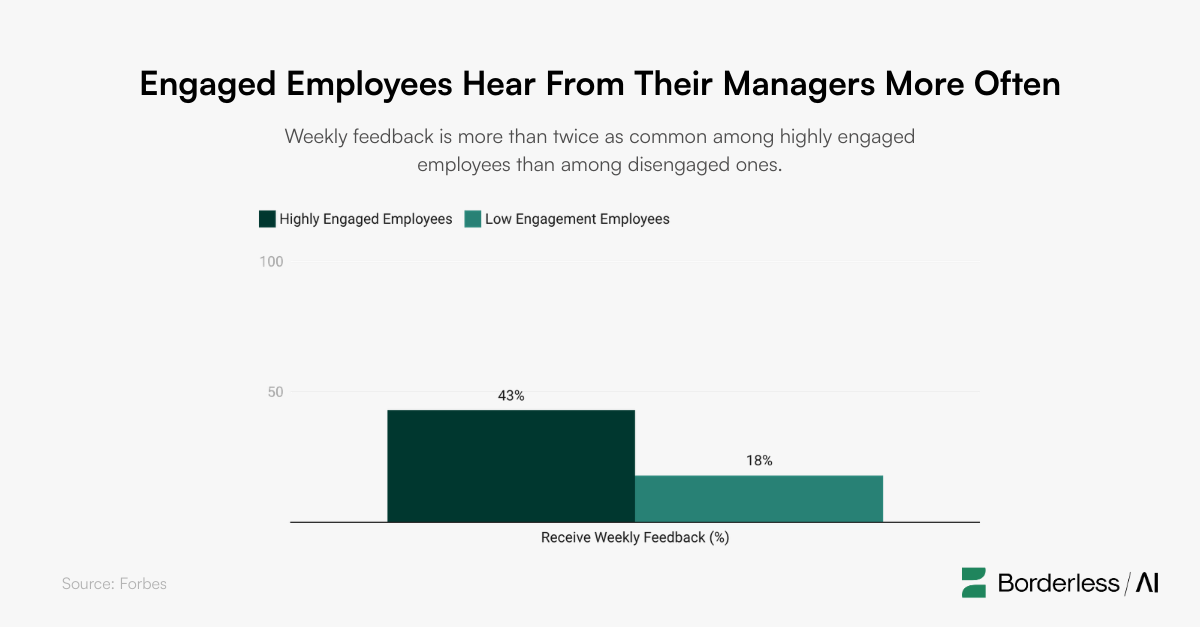
- 43% of highly engaged employees receive feedback at least once per week, compared to just 18% of employees with low engagement, suggesting a strong link between feedback frequency and how invested employees feel in their work.
- Short feedback conversations lasting 15 to 30 minutes are more effective than longer meetings when they occur regularly. Consistency matters more than duration.
- When weekly feedback does not happen, managers often need longer conversations to catch up, reducing efficiency and impact.
- 3 in 10 U.S. employees strongly agree with the statement ‘In the last seven days, I have received recognition or praise for doing good work’, indicating that most workers feel their day-to-day contributions go largely unnoticed.
How Does Employee Feedback Impact Engagement and Performance?
Feedback that is consistent has a positive impact on the success of businesses as it allows teams to adapt faster, improve faster, and remain focused on their objectives. Employees who are aware of their performance status will spend less time "winging" it, less time duplicating efforts, and less time headed in the wrong direction.
As employees receive consistent feedback, over time, it should result in better team performance, less employee turnover, and more predictable results, particularly for companies whose priorities frequently shift.
- Employees who receive strengths-based feedback experience turnover rates nearly 15% lower than those who receive no feedback. Simply shifting the focus of feedback toward what employees do well (rather than only what needs fixing) can have a measurable impact on retention.
- Teams led by managers who receive feedback show 12.5% higher productivity than teams without feedback-driven leadership.
- Business units with managers who receive feedback report 8.9% higher profitability
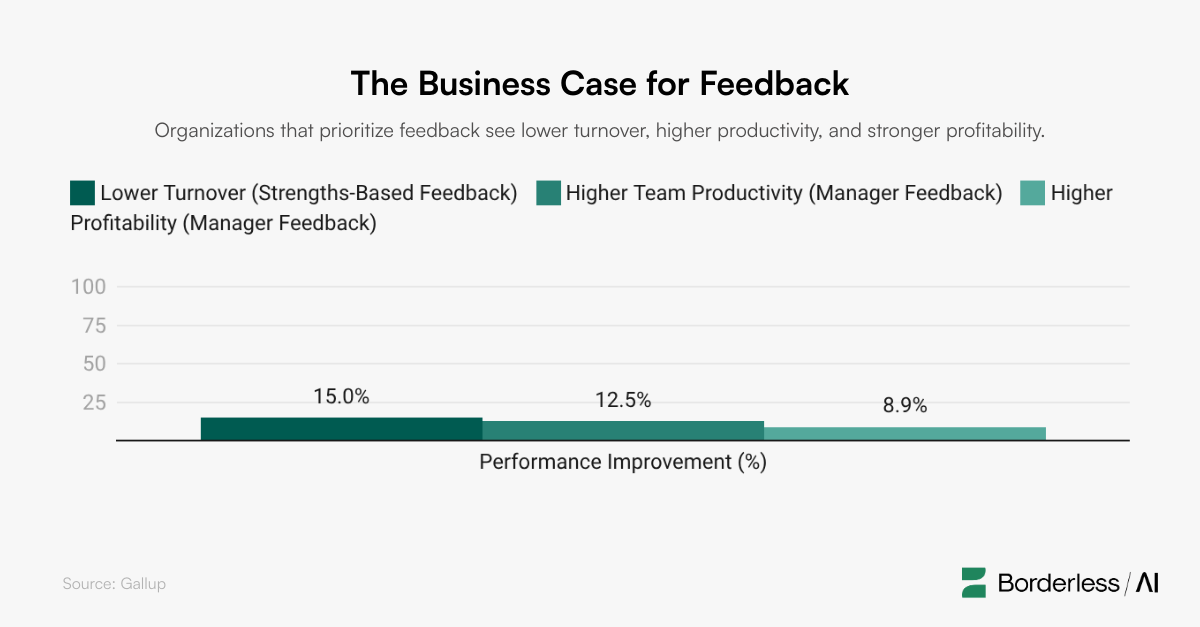
- than those where managers receive none. This suggests that building a feedback culture isn't just good for morale, it has a direct impact on the bottom line.
- 80% of employees who received meaningful feedback in the past week are fully engaged, regardless of whether they work remotely, hybrid, or in person.
- Employees who say they are not adequately recognized are 3 times more likely to say they will quit within the next year. Recognition doesn't need to be elaborate but its absence carries a significant flight risk.
- Employees who strongly believe they receive valuable performance feedback from colleagues are 57% less likely to experience burnout.
- Those who strongly agree that they receive valuable performance feedback are also 48% less likely to be actively job searching or considering other opportunities.
- Among surveyed employees, a single meaningful feedback conversation can noticeably improve engagement levels. Organizations don't need to overhaul their entire feedback infrastructure to see results; sometimes one genuine, well-timed conversation is enough to make a difference.
How Do Positive and Negative Feedback Affect Employees?
Positive Feedback alone is typically not enough to address employee concerns regarding their performance. However, in growth-focused feedback, you will be able to provide employees with those answers: "what are you doing well?", "what do you need to change?", and "how do you become a better performer?"
Growth-focused feedback is an opportunity for everyday work to be viewed as an opportunity for learning rather than guessing how to perform better.
- 92% of employees agree that negative feedback improves performance when delivered appropriately. The issue isn't that employees can't handle criticism; it's that how that criticism is framed and communicated makes all the difference.
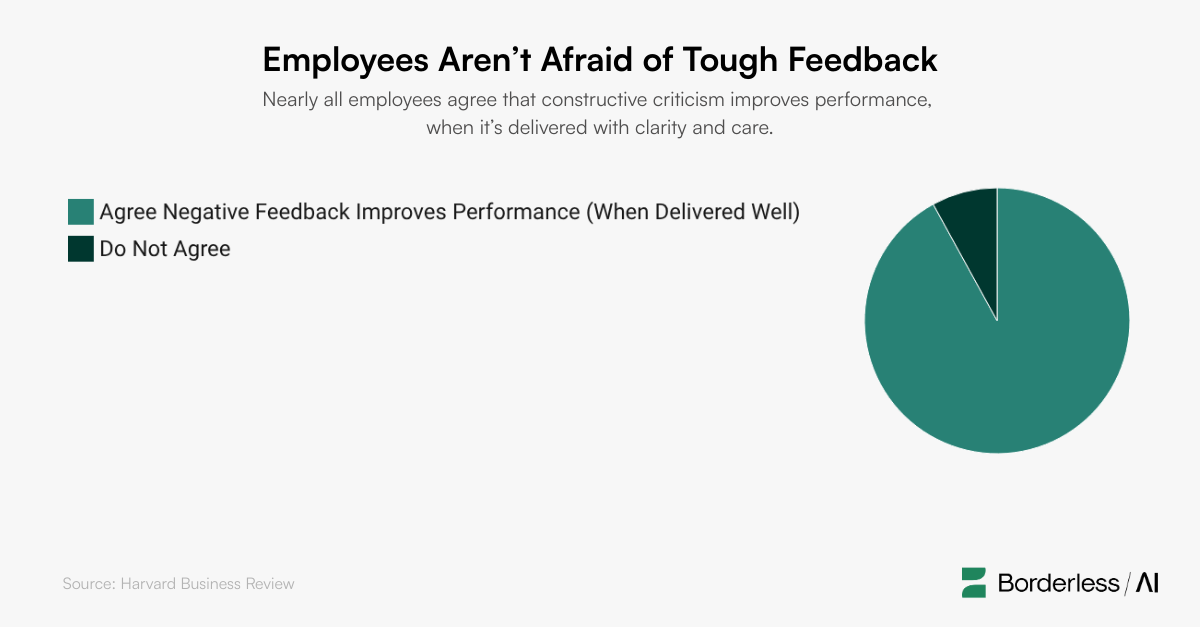
- In a separate survey, 94% of feedback recipients said corrective feedback improves performance when it is presented well, reinforcing that delivery and context matter. Taken together with similar findings, this reinforces a consistent theme: employees don't resist tough feedback, they resist poor delivery.
- In a survey of 2,700 respondents, almost two-thirds said more feedback would have substantially improved their performance and career success.
- 63% of respondents of that survey said they received substantially more positive feedback than corrective feedback.
- In addition, 64% of respondents said they are not praised or recognized too much pushing back on the common concern that organizations risk over-praising. Most employees feel there's still plenty of room for more recognition, not less.
- 82% of employees say they appreciate both positive and negative feedback, rather than praise alone.
- Despite this, only 26% of employees strongly believe the feedback they receive helps them do their job better, pointing to a quality gap - employees are getting feedback, but much of it isn't landing in a way that feels useful or actionable.
- Balanced feedback that includes direction and clarity leads to stronger performance outcomes than positive feedback alone. Praise keeps employees motivated, but it's the clarity and honesty in constructive feedback that drives real improvement.
What Feedback Gaps Exist Between Managers and Employees?
Many feedback programs fail at the execution stage. Feedback may be given, but it is inconsistent, poorly timed, or disconnected from how success is measured. When this happens repeatedly, employees stop viewing feedback as helpful guidance and start seeing it as noise.
- Only 16% of employees say their most recent feedback conversation felt deeply meaningful. While many organizations have feedback processes in place, the vast majority of those interactions aren't resonating with employees in a way that feels impactful or memorable.
- Just 12% of employees have been asked how they prefer to be recognized or appreciated. Without understanding individual preferences, even well-intentioned recognition efforts risk falling flat, turning what should feel personal into something generic.
- Only 13% of employees strongly agree they know how other people at work like to be recognized.
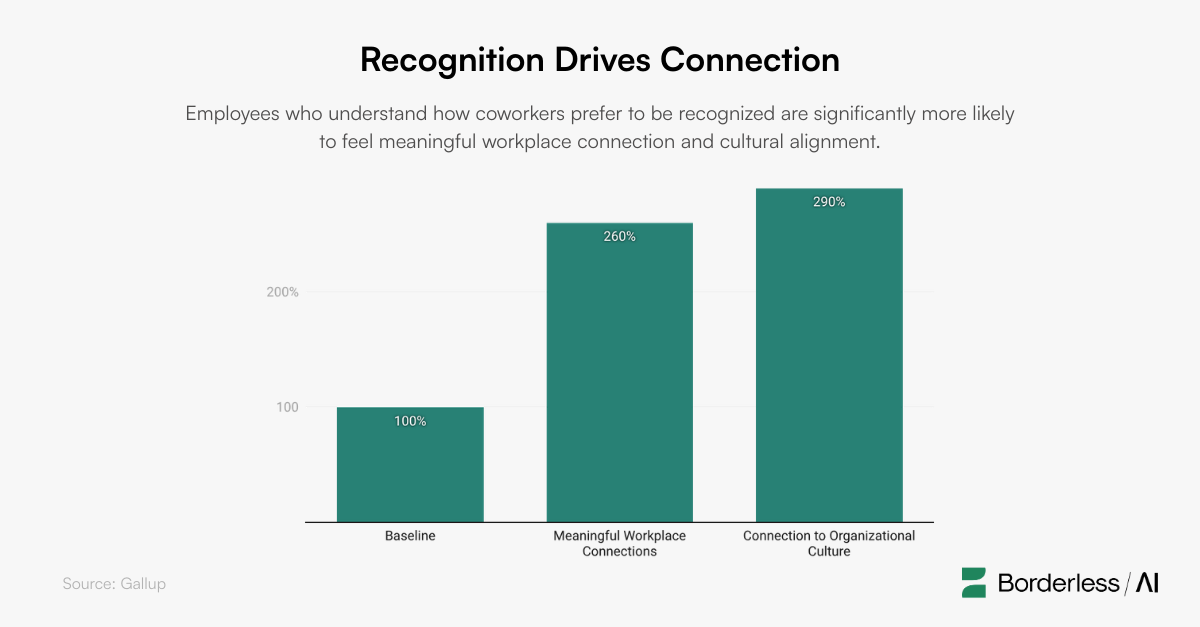
- Employees who strongly agree they know how coworkers like to be recognized are 2.6 times more likely to strongly agree they have meaningful connections at work.
- Those employees are also 2.9 times more likely to strongly agree they feel connected to their organization’s culture.
- 46% of employees say they receive peer recognition at least a few times per month, while 38% say they receive manager recognition that often.
- Employees who report feeling well recognized were 45% less likely to leave their organization over a two-year tracking period.
- Only 42% of employees have the opportunity to formally provide feedback to their manager. For the majority of the workforce, feedback flows in only one direction, limiting managers' ability to grow and leaving employees feeling unheard.
- Half of employees say their manager does not adjust feedback based on their career goals, missing opportunities for growth. When feedback is generic rather than tailored to where an employee wants to go, it misses the opportunity to serve as a genuine development tool, and employees notice.
How Does Feedback Support Employee Development?
Feedback is most effective when it helps employees learn and progress by giving them clarity and confidence in their next steps. When people understand what to work on and why it matters, they are more likely to take ownership of their development. Over time, this kind of feedback builds capability instead of dependence on constant direction.
- 72% of employees say constructive feedback from managers is important for career development, yet only 5% believe they receive enough of it. This is one of the starkest gaps in the feedback landscape: employees overwhelmingly recognize the value of constructive input, but almost none feel they're getting what they need to grow.
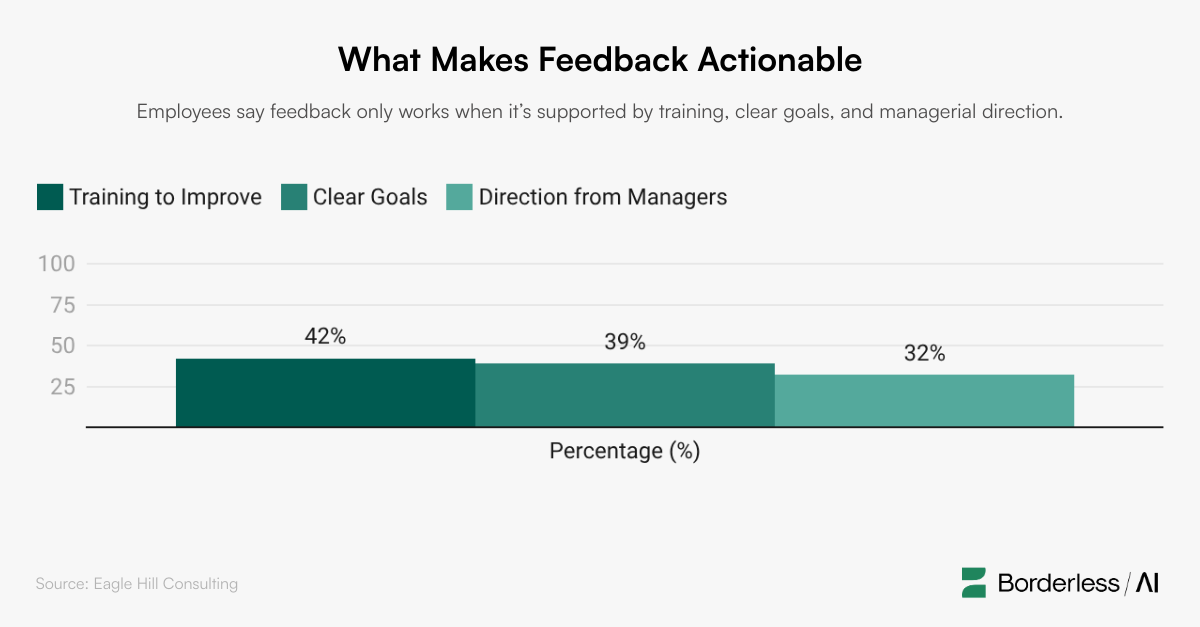
- Employees say they need training (42%), clear goals (39%), and direction from managers (32%) for feedback to be actionable.
- 68% of employees feel better supported by their supervisor when feedback is constructive and consistent.
- 46% of employees feel pleased, and 45% feel motivated after regular performance check-ins, showing the emotional impact of feedback.
What Are the Employee Feedback Trends for 2026?
Feedback is most useful when employees can still act on it. In many workplaces, feedback arrives after a project ends, which limits its impact. When feedback is shared closer to the work itself, employees can adjust, improve results, and build stronger habits over time instead of revisiting mistakes after the moment has passed.
- More than 75% of HR leaders believe annual performance reviews do not accurately reflect employee contributions. When the majority of the people responsible for designing review systems don't trust them to work, it raises serious questions about whether organizations are measuring performance or just going through the motions.
- Over 90% of managers report frustration with traditional review processes. The very people tasked with delivering reviews find them ineffective, suggesting that the push for change isn't coming from a fringe, but it's a near-universal sentiment among leadership.
- Performance evaluations can cost $2.4 million to $35 million per year in lost working hours for a 10,000-employee company.
- Only 14% of employees strongly agree that performance reviews inspire them to improve. For a process that's meant to drive development and motivation, this is a remarkably low success rate, suggesting that most traditional reviews aren't achieving their core purpose.
- Managers spend 210 hours per year on performance-related activities, while employees spend about 40 hours, often with limited return.
- Managers who receive regular feedback themselves show higher team engagement and significantly lower turnover, with benefits that compound over time.
Feedback Quality and Retention Risk
When feedback lacks clarity or direction, employees notice. Poor-quality performance feedback is linked to higher turnover risk, and many workers say insufficient feedback plays a direct role in their decision to look elsewhere.
- People receiving low-quality performance feedback were 63% more likely to leave than others.
- 17% of respondents named insufficient feedback as a primary reason they are looking for other roles. While compensation and career progression often dominate retention conversations, this finding suggests that feedback (or the lack of it) plays a more significant role in attrition than many organizations realize.
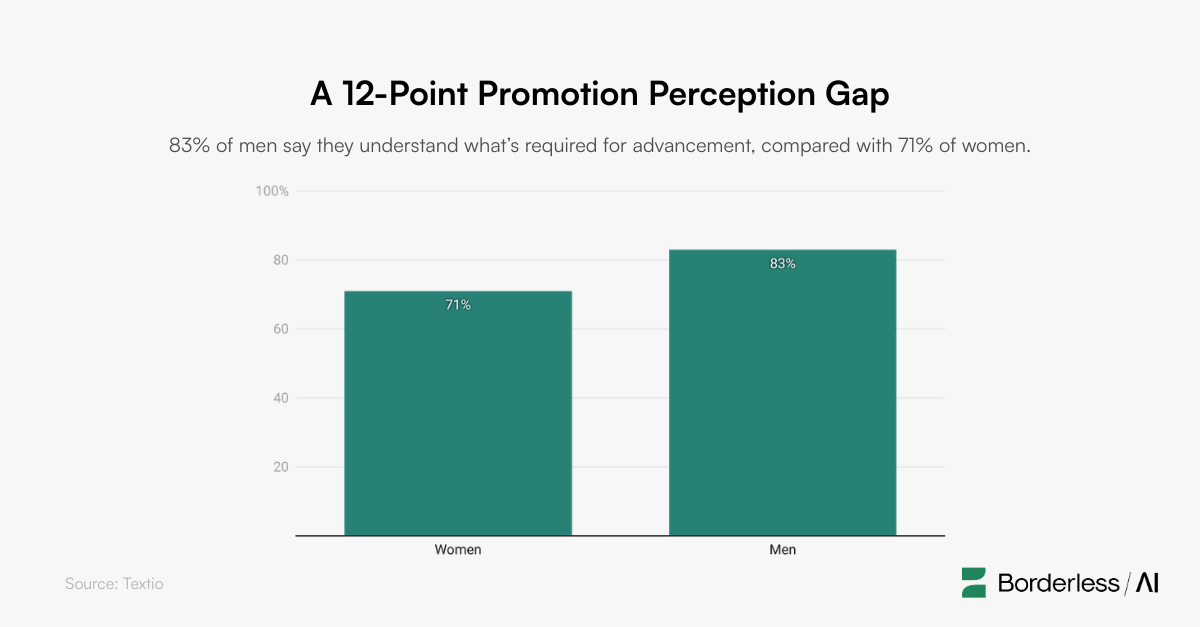
- 71% of women say they understand what is required for their next promotion, compared with 83% of men.
Feedback Is How Strong Teams Win in 2026
The employee feedback statistics of 2026 send a clear message: people want to know how they’re doing. When feedback is timely and clear, they perform better, stay longer, and feel more engaged.
The companies moving ahead in 2026 are building continuous feedback cultures, beyond annual reviews. They’re prioritizing clear expectations, meaningful recognition, and development conversations that actually help people improve.
For global teams, this can be harder to manage. Different countries, labor laws, and employment rules add complexity. That operational burden can take attention away from building strong performance systems.
This is where services like Borderless AI can help. As an employer of record service, Borderless AI manages international hiring and compliance, so companies do not need to set up local entities. With that foundation in place, leaders can focus on what the research consistently shows works: regular feedback, aligned goals, and real employee growth.
Reference List
“Annual Performance Reviews Are Dead.” SHRM, 2023, www.shrm.org/mena/topics-tools/news/employee-relations/annual-performance-review-dead.
“Employees Say Team Performance Improved During the Pandemic.” Eagle Hill Consulting, 2021, www.eaglehillconsulting.com/news/employees-say-team-performance-improved-during-pandemic/.
“Failure Drives Innovation, According to EY Survey on Gen Z.” PR Newswire, 2018, www.prnewswire.com/news-releases/failure-drives-innovation-according-to-ey-survey-on-gen-z-300714436.html.
“Fast Feedback Fuels Performance.” Gallup, 2022, www.gallup.com/workplace/357764/fast-feedback-fuels-performance.aspx.
“Feedback Is Not Enough.” Gallup, 2019, www.gallup.com/workplace/257582/feedback-not-enough.aspx.
Gallup. “From Praise to Profits: The ROI of Recognition.” www.gallup.com/workplace/236951/praise-praising-employees.aspx.
Gallup. “Harm of the Good Truth About Performance Reviews.” www.gallup.com/workplace/249332/harm-good-truth-performance-reviews.aspx.
Gallup. State of the American Workplace Report (PDF), 2025, www.gallup.com/file/workplace/238085/Gallup_State_of_the_American_Workplace_Report.pdf.
Gallup and Workhuman. The Human-Centered Workplace. 2024, www.gallup.com/file/analytics/650567/Gallup-Workhuman_Human-Centered-Workplace-Report.pdf.
Gambill, Tony. “Two Common Mistakes Leaders Make About Developing a Healthy Feedback Culture.” Forbes, 6 June 2022, www.forbes.com/sites/tonygambill/2022/06/06/two-common-mistakes-leaders-make-about-developing-a-healthy-feedback-culture/.
Harter, Jim. “Why Strengths Matter.” Gallup Business Journal, 2013, news.gallup.com/businessjournal/153341/why-strengths-matter-training.aspx.
Harter, Jim, and Jim Asplund. “The Secret to Higher Performance.” Gallup Business Journal, 2011, news.gallup.com/businessjournal/147383/secret-higher-performance.aspx.
“Millennials at Work: Reshaping the Workplace.” PwC, 2013, www.pwc.com/m1/en/services/consulting/documents/millennials-at-work.pdf.
Mann, Annamarie. “The Great Manager’s Most Important Habit.” Gallup, 2023, www.gallup.com/workplace/505370/great-manager-important-habit.aspx.
“Negative Feedback Is the Best Way to Improve Performance.” Harvard Business Review, Jan. 2014, hbr.org/2014/01/your-employees-want-the-negative-feedback-you-hate-to-give.
“Receiving and Giving Effective Feedback.” University of Waterloo Centre for Teaching Excellence, www.uwaterloo.ca/centre-for-teaching-excellence/catalogs/tip-sheets/receiving-and-giving-effective-feedback.
“Strengths, Weaknesses, and Blind Spots in Manager Feedback.” Gallup, 2023, www.gallup.com/workplace/645299/strengths-weaknesses-blind-spots-managers.aspx.
Textio. “Feedback Bias 2023 Report.” 2023, https://textio.com/feedback-bias-2023.
“Why Employee Recognition Matters.” Robert Half, 2022, www.roberthalf.com/us/en/insights/management-tips.
“Why Employees Crave Feedback and Why We’re Afraid to Give It.” Harvard Business School Working Knowledge, 2019, www.library.hbs.edu/working-knowledge/why-people-crave-feedback-and-why-were-afraid-to-give-it.
Zenger Folkman. Feedback: The Powerful Paradox. 2019, zengerfolkman.com/wp-content/uploads/2019/05/EF%E2%80%94White-Paper%E2%80%94Feedback-The-Powerful-Paradox.pdf.




.avif)
.avif)

