
Employer of Record Guide in Zambia
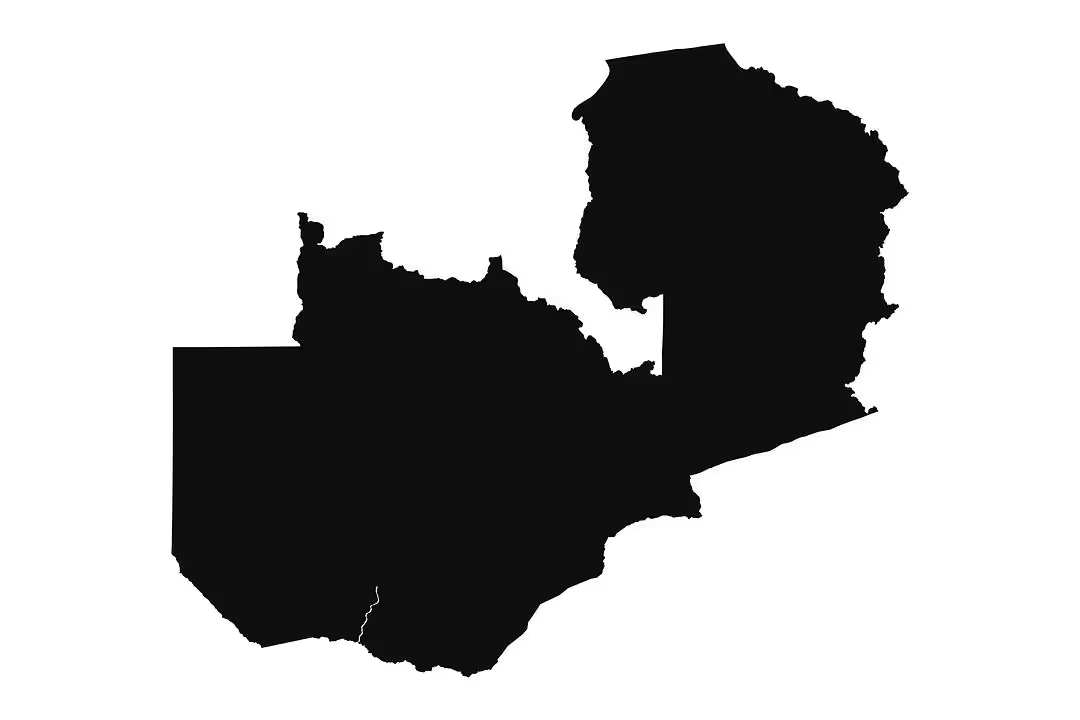
Zambia's growing economy and skilled workforce present incredible opportunities for global companies, but navigating local employment laws and compliance requirements can feel overwhelming. Our comprehensive guide breaks down everything you need to know to hire confidently and compliantly in this dynamic Southern African market.
Capital City
Currency
Languages
Population size
Key stats and facts
From Lusaka's bustling business district to the Copperbelt's industrial centers, Zambia offers access to diverse talent across mining, engineering, and emerging tech sectors. Understanding the local market dynamics—including tax structures, economic hubs, and in-demand skills—is your first step toward successful expansion.
Major economic hubs
Skills in demand
Currency
Language
GDP per Capita
Standard Tax Rate
Your EOR guide in Zambia
Getting payroll, benefits, and compliance right in Zambia requires navigating sector-specific minimum wages, progressive tax brackets, and comprehensive leave policies. This detailed breakdown covers everything from NAPSA contributions to holiday pay rules, giving you the clarity you need to manage your Zambian workforce effectively.
Minimum Wage
Zambia operates a sector-based minimum wage system that varies by industry and region. The government periodically reviews and adjusts these rates through the Ministry of Labour and Social Security.
Current minimum wage rates vary by:
- Sector: Manufacturing, agriculture, domestic work, and general labour have different rates
- Region: Urban vs rural areas may have different minimums
- Company size: Some variations based on number of employees
Note: Writers should verify current minimum wage rates as these are subject to regular government updates.
Payroll Cycle
- Monthly: Most common payment frequency
- Bi-weekly: Acceptable but less common
- Weekly: Primarily for casual or temporary workers
All salaries must be paid in Zambian Kwacha (ZMW) unless special approval is obtained for foreign currency payments.
Individual Income Tax
Zambia operates a progressive income tax system administered by the Zambia Revenue Authority (ZRA).
Pay As You Earn (PAYE) Tax Brackets:
| Monthly Income (ZMW) | Tax Rate |
|---|---|
| 0 - 4,000 | 0% |
| 4,001 - 4,800 | 25% |
| 4,801 - 6,900 | 30% |
| Above 6,900 | 37.5% |
Note: Tax brackets are subject to annual budget adjustments. Writers should verify current rates.
Tax Residency Criteria
Individuals are considered Zambian tax residents if they:
- Reside in Zambia for 183 days or more in a tax year
- Have their permanent home in Zambia
- Are Zambian citizens working abroad for the government
Tax residents pay tax on worldwide income, while non-residents pay tax only on Zambian-source income.
Employer Payroll Contributions
Employers must make several mandatory contributions beyond the employee's gross salary:
| Contribution Type | Employer Rate | Employee Rate | Total |
|---|---|---|---|
| National Pension Scheme Authority (NAPSA) | 5% | 5% | 10% |
| Workers' Compensation Fund | 1% | 0% | 1% |
| Skills Development Levy | 0.5% | 0% | 0.5% |
Additional considerations:
- NAPSA contributions are capped at maximum salary levels
- Workers' compensation rates may vary by industry risk level
- Skills development levy applies to companies with payroll above certain thresholds
Working Hours
The standard working arrangement in Zambia follows the Employment Code Act:
- Normal hours: 8 hours per day, 48 hours per week
- Maximum daily hours: 10 hours (including overtime)
- Rest periods: Minimum 1 hour lunch break for shifts over 6 hours
- Weekly rest: Minimum 24 consecutive hours per week
Overtime Pay
- Overtime rate: 1.5 times the normal hourly rate
- Overtime threshold: Hours worked beyond 8 per day or 48 per week
- Maximum overtime: 12 hours per week unless exceptional circumstances
- Sunday work: Double time rate applies
- Public holiday work: Double time rate applies
Employment Classifications
Permanent Employment:
- Full-time positions with indefinite duration
- Full benefits and job security protections
- Subject to standard notice periods for termination
Fixed-term Contracts:
- Maximum 24 months duration
- Can be renewed once for additional 24 months
- Automatic conversion to permanent after 48 months
Casual Employment:
- Day-to-day or short-term work
- Limited to 6 months in any 12-month period
- Fewer benefits and protections
Annual Leave
- Entitlement: 24 working days per year after 12 months of continuous service
- Pro-rata: Available proportionally during first year
- Carry-over: Up to 6 days may be carried to following year
- Cash-out: Unused leave must be paid out on termination
- Scheduling: Subject to employer approval and operational requirements
Sick Leave
Zambian employees are entitled to comprehensive sick leave provisions:
- Total entitlement: 156 days over any 3-year period
- Medical certificate: Required for absences over 2 consecutive days
- Payment: Full pay for first 7 days, then reduced rates
- Chronic conditions: Special provisions for long-term illnesses
Maternity Leave
- Duration: 84 days (12 weeks)
- Payment: Full salary for entire period
- Timing: Can commence up to 6 weeks before expected delivery
- Job protection: Position must be held open during leave
- Medical requirements: Medical certificate confirming pregnancy
Paternity Leave
- Duration: 10 working days
- Payment: Full salary
- Timing: Must be taken within 30 days of birth
- Documentation: Birth certificate required
Compassionate Leave
- Duration: Up to 7 days for immediate family bereavement
- Payment: Full salary
- Documentation: Death certificate or funeral notice required
- Extended leave: Additional unpaid leave may be granted
Study Leave
- Availability: For job-related education and training
- Duration: Varies based on course requirements
- Payment: May be paid or unpaid depending on employer policy
- Conditions: Often requires commitment to remain with employer post-study
Summary
| Leave Type | Duration | Payment | Requirements |
|---|---|---|---|
| Annual Leave | 24 working days/year | Full pay | 12 months service |
| Sick Leave | 156 days/3 years | Full pay (first 7 days) | Medical certificate |
| Maternity Leave | 84 days | Full pay | Medical certificate |
| Paternity Leave | 10 working days | Full pay | Birth certificate |
| Compassionate Leave | Up to 7 days | Full pay | Death certificate |
| Study Leave | Varies | Varies | Employer approval |
Termination Categories
Termination with Cause:
- Gross misconduct (theft, fraud, violence)
- Serious breach of contract
- Repeated minor offences after warnings
- No notice or severance required
Termination without Cause:
- Redundancy due to business needs
- Poor performance (after proper process)
- Requires notice period and potential severance
Mutual Agreement:
- Both parties agree to end employment
- Terms negotiated between employer and employee
Notice Period Requirements
Notice periods vary based on employment level and length of service:
| Employment Category | Notice Period |
|---|---|
| General workers | 1 month |
| Supervisory staff | 2 months |
| Management positions | 3 months |
| Senior management | 3 months |
Payment in lieu of notice is permitted if employer prefers immediate termination.
Severance Pay
Redundancy payments are required when positions are eliminated:
- Calculation: 1 month's salary for each completed year of service
- Minimum: 1 month's salary regardless of service length
- Maximum: No statutory maximum
- Payment timing: Must be paid with final salary
Retrenchment benefits may include additional compensation beyond statutory minimums.
Disciplinary Process
Before termination for cause, employers must follow proper disciplinary procedures:
- Investigation: Thorough investigation of alleged misconduct
- Hearing: Employee right to respond to allegations
- Representation: Employee may have union or colleague representation
- Documentation: Written records of all proceedings
- Appeal: Right to appeal disciplinary decisions
Final Pay Requirements
Final payments must include:
- Outstanding salary up to termination date
- Accrued annual leave
- Any overtime or allowances due
- Severance pay (if applicable)
- Notice pay (if applicable)
Payment deadline: Within 7 days of termination or next regular pay date, whichever is sooner.
National Public Holidays
Zambia observes 13 national public holidays annually:
| Holiday | Date | Type |
|---|---|---|
| New Year's Day | January 1 | Fixed |
| Youth Day | March 12 | Fixed |
| Good Friday | Varies | Religious |
| Easter Monday | Varies | Religious |
| Labour Day | May 1 | Fixed |
| Africa Day | May 25 | Fixed |
| Heroes Day | First Monday in July | Fixed |
| Unity Day | First Tuesday in July | Fixed |
| Farmers' Day | First Monday in August | Fixed |
| Independence Day | October 24 | Fixed |
| Christmas Day | December 25 | Fixed |
| Boxing Day | December 26 | Fixed |
Regional Observances
Some regions may observe additional local holidays or cultural celebrations, though these are not typically statutory holidays requiring paid time off.
Holiday Pay Rules
Eligibility requirements:
- Must have worked the day before and after the holiday (unless on approved leave)
- Applies to all permanent and fixed-term employees
- Casual workers may have different entitlements
Payment rates:
- Normal holiday pay: Regular daily wage
- Working on holiday: Double time rate
- Substitute holidays: If holiday falls on rest day, following working day becomes holiday
Religious Accommodations
Employers should reasonably accommodate employees' religious observances, which may include:
- Time off for religious holidays not covered by national holidays
- Flexible scheduling for prayer times
- Dietary accommodations during religious periods
Required Documentation
Employment Contract must include:
- Job title and description
- Salary and benefits
- Working hours and location
- Leave entitlements
- Termination clauses
- Disciplinary procedures
Employee Documentation:
- National Registration Card (NRC)
- Tax Identification Number (TPIN)
- Bank account details for salary payments
- Educational certificates (if relevant)
- Previous employment references
Work Permits & Visas
For foreign employees:
- Work permit required before commencement
- Self-employment permit for certain categories
- Residence permit for long-term stays
- Dependent permits for family members
Application process:
- Submit application to Department of Immigration
- Provide employment contract and qualifications
- Medical examination may be required
- Processing time varies (typically 30-60 days)
Tax Registration
PAYE Registration:
- Employer must register with Zambia Revenue Authority
- Obtain PAYE certificate
- Monthly returns and payments required
Employee Tax Numbers:
- All employees need Tax Identification Numbers (TPIN)
- Required for salary payments and tax compliance
Social Security Registration
NAPSA Registration:
- Both employer and employee must register
- Obtain NAPSA numbers for contributions
- Monthly contribution submissions required
Banking Requirements
- Employees typically need local bank accounts
- Salary payments usually made via bank transfer
- Some employers may offer mobile money options
Probationary Periods
- Standard duration: Up to 6 months
- Performance evaluation: Regular assessments during probation
- Termination: Shorter notice periods during probation
- Confirmation: Written confirmation required after successful probation
Onboarding Timeline
| Step | Timeline |
|---|---|
| Job offer accepted | Day 0 |
| Work permit application (if needed) | Day 1-60 |
| Employment contract signed | Day 1-3 |
| Tax and NAPSA registration | Day 3-7 |
| Bank account setup | Day 5-10 |
| Onboarding and orientation | Day 7-14 |
| Probation period begins | Day 1 |
Worker Classification
Zambian employment law recognises several worker categories with different rights and obligations:
Employees vs Independent Contractors:
- Control test: Level of supervision and direction
- Integration test: How integral work is to business
- Economic reality test: Who bears financial risk
- Mutuality of obligation: Ongoing relationship expectations
Misclassification can result in penalties, back payments of benefits, and tax liabilities.
Trade Unions & Collective Bargaining
- Union membership: Voluntary but common in many sectors
- Collective agreements: May override individual contract terms
- Industrial relations: Formal dispute resolution processes
- Strike action: Legal with proper procedures followed
Health & Safety Requirements
Employer obligations:
- Provide safe working environment
- Safety training and equipment
- Accident reporting and investigation
- Workers' compensation insurance coverage
Employee rights:
- Right to refuse unsafe work
- Safety training and information
- Compensation for work-related injuries
Anti-Discrimination Laws
Protected characteristics include:
- Race and ethnicity
- Gender and pregnancy
- Religion and belief
- Disability
- HIV status
- Political affiliation
Harassment and discrimination are prohibited and can result in legal action and penalties.
Remote Work Considerations
While not extensively regulated, remote work arrangements should address:
- Equipment provision: Who provides computers, internet, etc.
- Health and safety: Home office safety requirements
- Working hours: Maintaining standard hour limits
- Communication: Regular check-ins and availability
- Data security: Protection of company information
Compliance Monitoring
Government agencies involved:
- Ministry of Labour and Social Security
- Zambia Revenue Authority (tax compliance)
- NAPSA (social security contributions)
- Department of Immigration (work permits)
Regular requirements:
- Monthly tax and NAPSA returns
- Annual employment equity reports
- Safety inspection compliance
- Union agreement adherence (where applicable)
What Borderless AI Handles:
When you hire through Borderless AI in Zambia, we manage:
- Employment contract drafting and compliance
- Payroll processing and tax withholding
- NAPSA and other statutory contributions
- Leave management and tracking
- Termination procedures and documentation
- Government reporting and compliance
- Local HR support and guidance
This ensures your Zambian employees receive full legal protections while you maintain compliance with all local employment regulations.
Built-in benefits packages for Zambia
When the world is your competition, it pays to incentivize new hires and existing alike. Borderless AI benefits packages typically include:

Medical Insurance

Dental Insurance

Retirement Contribution

Life Insurance

Vision Insurance
Explore other countries

Unlock global hiring potential
Simplify your payroll and hiring processes today.