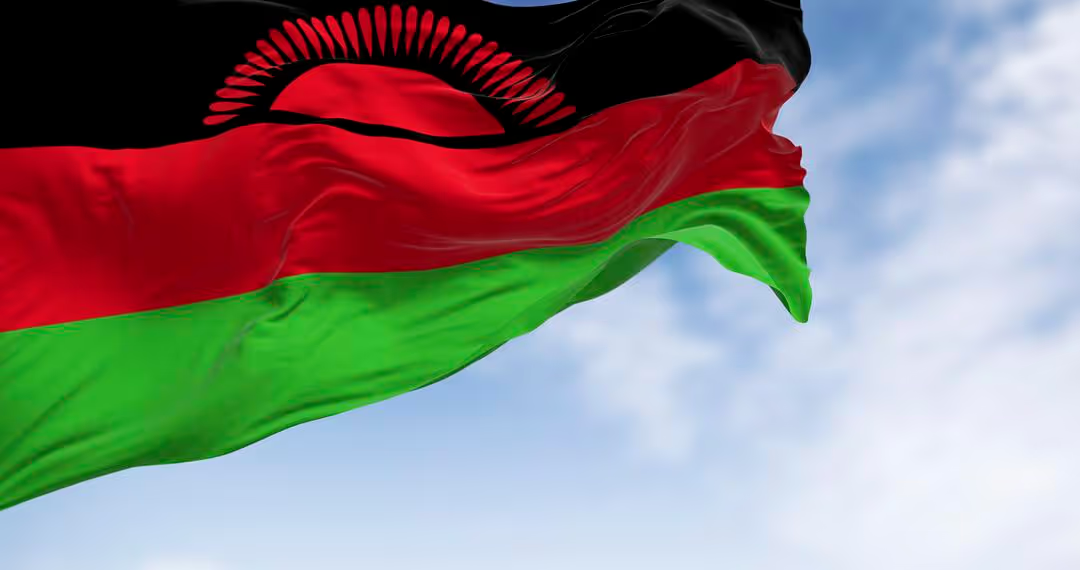
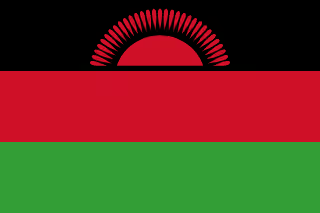
Employer of Record Guide in Malawi
Malawi's growing economy offers incredible talent opportunities, but navigating local employment laws and compliance requirements can feel overwhelming. Our comprehensive guide breaks down everything you need to know to hire confidently and compliantly in this emerging market.
Capital City
Currency
Languages
Population size

Key stats and facts
From Lilongwe's tech scene to Blantyre's financial sector, Malawi's diverse economic landscape spans multiple industries with competitive talent pools. Understanding the local market dynamics—including tax structures, language requirements, and regional hubs—sets the foundation for successful hiring decisions.
Major economic hubs
Skills in demand
Currency
Language
GDP per Capita
Standard Tax Rate
Your EOR guide in Malawi
Getting payroll, benefits, and compliance right in Malawi requires navigating sector-specific minimum wages, progressive tax systems, and evolving labor regulations. Here's your practical roadmap to managing everything from working hours to leave policies while staying compliant with local requirements.
Minimum Wage
Malawi sets sector-specific minimum wages rather than a universal rate. The minimum wage varies by industry and is typically reviewed annually by the Ministry of Labour.
Note: Specific current minimum wage rates by sector require verification with the Malawi Ministry of Labour, as rates are subject to regular adjustment.
Payroll Cycle
- Monthly: Most common payment frequency in Malawi
- Bi-weekly: Less common but acceptable
- Weekly: Primarily used for casual labour positions
Note: Employers must ensure consistent payment schedules and comply with local banking regulations.
Individual Income Tax
Malawi operates a progressive income tax system administered by the Malawi Revenue Authority (MRA).
Note: Current tax brackets and rates should be verified with the Malawi Revenue Authority, as tax rates are subject to annual budget adjustments.
Tax Residency Criteria
Individuals who reside in Malawi for 183 days or more in a tax year are considered tax residents and must pay Malawian income tax on their worldwide income. Non-residents are taxed only on Malawian-source income.
Employer Payroll Contributions
Employers in Malawi are required to make several statutory contributions on behalf of their employees:
- Pay As You Earn (PAYE): Income tax withholding
- Social Security Contributions: Contributions to social security schemes
- Skills Development Levy: Training and development fund contributions
Note: Specific contribution rates and thresholds should be verified with the Malawi Revenue Authority and relevant statutory bodies.
Working Hours
The standard working week in Malawi is 48 hours, typically structured as 8 hours per day over 6 days, or alternative arrangements that don't exceed the weekly limit.
Certain categories of employees—such as senior managers and professionals—may have flexible working arrangements, but must still comply with maximum hour regulations.
Overtime Pay
- Overtime is paid at 1.5× the employee's regular hourly rate for hours worked beyond standard working hours
- Daily Limit: Work beyond 8 hours per day typically qualifies for overtime
- Weekly Limit: Work beyond 48 hours per week requires overtime compensation
- Rest Periods: Employees are entitled to adequate rest between shifts
Bonus Payments
While not legally mandated, bonuses are common in Malawi's formal employment sector. When promised contractually or paid regularly, bonuses may become an entitlement affecting termination calculations.
Full-Time vs. Part-Time
- Full-time: Employees working the standard 48-hour week or equivalent
- Part-time: Employees working fewer hours with proportional benefits
Annual Leave
- Standard Entitlement: Minimum 18 working days of paid annual leave after 12 months of continuous service
- Accrual: Leave typically accrues monthly
- Payout Rules: Unused leave must be compensated upon termination
Sick Leave
- Entitlement: Employees are entitled to paid sick leave, typically up to a specified number of days per year
- Medical Certification: Doctor's certificates may be required for extended sick leave
- Chronic Illness: Special provisions may apply for long-term medical conditions
Note: Specific sick leave entitlements should be verified with current Malawian labour legislation.
Maternity Leave
- Length: Female employees are entitled to maternity leave, typically 8-12 weeks
- Pay: Maternity leave is usually paid, though specific rates and funding sources require verification
- Job Protection: Employers must guarantee position security during maternity leave
Paternity Leave
- Entitlement: Male employees may be entitled to paternity leave
- Duration: Typically shorter than maternity leave
Note: Specific paternity leave provisions should be confirmed with current Malawian employment legislation.
Compassionate Leave
- Bereavement: Employees are typically entitled to paid leave for immediate family deaths
- Family Emergencies: Provisions for urgent family matters
- Duration: Usually 3-5 days depending on circumstances
Summary
| Leave Type | Duration | Paid? | Notes |
|---|---|---|---|
| Annual Leave | 18+ working days | Yes | After 12 months service |
| Sick Leave | Varies | Yes | Medical certification may be required |
| Maternity Leave | 8-12 weeks | Yes | Job protection guaranteed |
| Paternity Leave | Varies | Varies | Check current legislation |
| Compassionate Leave | 3-5 days | Yes | Immediate family circumstances |
Termination Types
Termination With Cause:
- Requires serious misconduct or breach of contract
- No notice period required
- Must follow proper disciplinary procedures
Termination Without Cause:
- Permitted with appropriate notice or payment in lieu
- Must not be discriminatory or unfair
Notice Period Requirements
Notice periods in Malawi typically depend on length of service and position level:
Note: Specific notice period requirements should be verified with current Malawian employment legislation, as these may vary by contract type and seniority level.
Severance Pay
- Eligibility: May apply after specified periods of continuous employment
- Calculation: Typically based on length of service and final salary
- Circumstances: Required for certain types of termination
Note: Severance pay requirements should be confirmed with current labour law provisions.
Final Pay Requirements
Employers must settle all outstanding payments including:
- Final salary
- Accrued annual leave
- Any other contractual entitlements
Payment timelines are typically specified in employment legislation.
Disciplinary Procedures
Malawian employment law requires fair disciplinary procedures before dismissal for cause, including:
- Written warnings
- Opportunity to respond
- Fair hearing process
- Right to representation
National Public Holidays
Malawi observes several national public holidays throughout the year:
Note: Specific public holiday dates should be verified annually, as some holidays may be moved to create long weekends or adjusted based on calendar considerations.
Religious Observances
- Christian Holidays: Christmas, Easter, and other Christian observances
- Islamic Holidays: Recognition of Islamic festivals where applicable
- Traditional Observances: Local cultural celebrations
Holiday Pay Requirements
Employees are typically entitled to:
- Full pay for public holidays
- Premium pay if required to work on public holidays
- Alternative days off if holidays fall on rest days
Required Documents for Employment
- Employment Contract: Must comply with Malawian labour law requirements
- Tax Registration: TPIN (Taxpayer Identification Number) registration
- Social Security Registration: Enrollment in applicable schemes
- Work Permits: For foreign employees
- Identity Documentation: National ID or passport verification
Background Checks
- Criminal Record Checks: May be required for certain positions
- Educational Verification: Confirmation of qualifications
- Reference Checks: Previous employment verification
- Professional Licensing: For regulated professions
Data Protection Compliance
Malawi has implemented data protection legislation that affects employee information handling:
- Data Protection Act 2024: Governs personal data processing
- MACRA Oversight: Malawi Communications Regulatory Authority involvement
- Consent Requirements: Employee consent for data collection and processing
Contract Requirements
Employment contracts must include:
- Job description and duties
- Salary and benefits
- Working hours and location
- Leave entitlements
- Termination procedures
- Dispute resolution mechanisms
Onboarding Timeline
| Step | Timeline |
|---|---|
| Job offer accepted | Day 0 |
| Contract preparation | Day 1-3 |
| Document collection | Day 3-7 |
| Government registrations | Day 5-10 |
| Payroll setup | Day 7-14 |
| Full onboarding completion | Day 10-14 |
Worker Classification
Proper classification between employees and independent contractors is crucial in Malawi:
- Employees: Subject to labour law protections, entitled to benefits, taxes withheld by employer
- Contractors: Independent service providers, responsible for own taxes and benefits
- Misclassification Risks: Can result in penalties and retroactive benefit payments
Cultural Considerations
Malawian workplace culture emphasises:
- Respect for Hierarchy: Traditional respect for seniority and authority
- Community Orientation: Collective decision-making and group harmony
- Religious Observance: Accommodation of Christian and other religious practices
- Language: English is the official business language, with Chichewa widely spoken
Remote Work Framework
Remote work arrangements in Malawi should consider:
- Infrastructure: Internet connectivity and power supply challenges
- Legal Framework: Compliance with employment law regardless of work location
- Equipment: Employer responsibilities for providing necessary tools
- Communication: Regular check-ins and performance management
Industry-Specific Considerations
Certain sectors in Malawi have additional requirements:
- Financial Services: Enhanced background checks and regulatory compliance
- Healthcare: Professional licensing and continuing education requirements
- Education: Teaching qualifications and registration requirements
- Mining: Safety certifications and environmental compliance
What Borderless AI Handles
When you hire through Borderless AI in Malawi, we manage:
- Local employment contract preparation
- Tax registration and compliance
- Payroll processing in Malawian Kwacha
- Statutory contribution management
- Leave administration
- Termination procedures and compliance
- Local regulatory updates and changes
Built-in benefits packages for Malawi
When the world is your competition, it pays to incentivize new hires and existing alike. Borderless AI benefits packages typically include:

Medical Insurance

Dental Insurance

Retirement Contribution

Life Insurance

Vision Insurance
Explore other countries




Unlock global hiring potential
Simplify your payroll and hiring processes today.